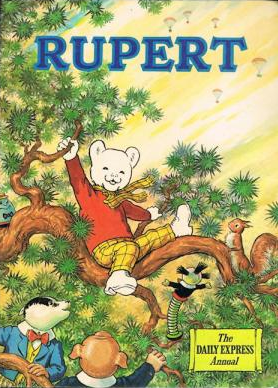
Why is Rupert Bear so popular ?

By Kevan Bundell

[1]

When it comes to fictional bears in Britain, there are three great allegiances:  to Paddington,  to Poo and to Rupert.  It may be that your family sensibly enjoyed all three.  Mine was exclusively devoted to Rupert.   This was the doing first of my Great-Uncle George and then of my Mother.   On the 3rd November 1930  Great-Uncle George cut out from the Daily Express newspaper part one of  a  new Rupert adventure  ‘Rupert and Bill keep shop’.  He did the same each day until  the adventure was complete and then gave the cuttings to his niece – my mother.  He continued to do the same, almost without interruption, until the 5th February 1937.

I know this because these cuttings are now on my bookshelves.  They lived for many years at my Grandma’s, each adventure in a numbered paper bag.   I must have gone through them a dozen times during my childhood.  When they  were passed to me and I came to sort them out I found the bag numbers were quite random and I had to consult the Rupert Museum in Canterbury to discover how to order them chronologically.  I then got Mum to slip them into photo albums in an organised fashion.  She recalled with pleasure how her Uncle George (with no children of his own) would bring each completed adventure and read them to her while she looked at the pictures.

My siblings and I were then brought up on Rupert Annuals from the mid 1950s to the mid ‘60s.   This means that while Mum was brought up on Rupert in a blue jumper (on the then contemporary book covers) and on stories written and illustrated by Rupert’s creator, Mary Tourtel, we were raised on the red-jumpered, yellow-check trousered  Rupert created by Alfred Bestall.  He took over the task of continuing the already hugely popular Rupert comic strip in 1935 when Mary Tourtel retired.

Rupert continues his adventures in the Daily Express and in Rupert Annuals even now.  New artists took over after Bestall retired in 1965 – but they were all obliged to follow him closely.  Since 2010 the paper and the annuals seem to rely on recycling old stories.  Fortunately there is no shortage – and the audience, of course, is renewed constantly.

But why did Rupert become so popular in the first place and why has he remained so popular ever since ?

Rupert is of course a bear.  He is not exactly a teddy-bear, but he is close enough.  By the time Rupert arrived, the teddy-bear was already a well established part of British childhood – a companion, a comfort at night, a half real, half imaginary friend.  At the same time, Rupert is also a child – with a mother, a father and a home.  (Rupert even has his own bedroom).  He is also, by the way, the ‘baby’ bear of three bears (even if there’s no Goldilocks).[2] Rupert and his family are both (teddy) bears and people.   Everything adds up to a character which a young child could and can still  identify with.

Rupert also has playmates – friends of his own age:  Bill Badger,  Algernon Pug, Edward Trunk, Podge the pig and the little girl Margot (all Tourtel creations), Pong Ping, Tiger Lilly, Gregory Guinea-pig, Rastus Mouse (introduced by Bestall) and many more.  He also has animal friends – Tourtel’s fox, Beppo the monkey and the ubiquitous black cat – somewhat like the pet a child might have at home – or might hope to have.  Rupert is also surrounded by caring grown-ups – not only his parents, but many others :  the Professor and his curious dwarf servant, Sailor Sam, the Wise Old Goat, the Nutwood police constable, even Gaffer Jarge.  In between, there are the three Girl Guides and Rollo the gypsy boy.

In other words, Rupert lives in a world which is caring, safe and full of friends of all ages – just like his young audience.

Rupert also has rather more secret friends –  the Imps of Spring, the merboy, the King of Birds and his entourage,  Jack Frost.  He also has friends which are really animate toys – the golly and the boy scout for example.  These are the kind of friends familiar to most children – in their imaginations.  He is even friends with Father Christmas himself !  Rupert also talks to animals and birds – the fox, the wise owl, the hedgehog, a passing sparrow.  Interestingly, these various friends are usually known only to Rupert himself, and not to his friends.  They are part of Rupert’s own secret, ‘imaginary’ world – just as his young audience might have their own secret, imaginary world known only to themselves, not even shared with friends.

Rupert also has adventures.   His adventures range from the scary to the mysterious and on to the enchanting – sometimes all of them within one story.  Tourtel’s adventures were often based on the traditionally menacing world of fairy-tales – with witches, ogres and gangs of robbers.  In fact she raided a whole range of children’s stories – some scary (pirates, a wolf in a bed, a wicked uncle, a Black Knight, African chiefs and white hunters, Red Indians), some friendly (Robinson Crusoe, Father Christmas), and some simply difficult (Humpty Dumpty).  When Bestall took over he was explicitly instructed that there should be no ‘bad characters’.   The editor was afraid  that the stories were in danger of scaring off their young audience.  So was Bestall, but he couldn’t help it.  In Rupert and the Travel Machine, for example, one of the earliest Bestall stories (1937) there’s an evil inventor who imprisons Rupert and Bill and will only set them free if they test his new invention.   In Rupert and the Pine Ogre (1957) we meet a megalomaniac Lord of Silence who plans to replace all the green woodland of Nutwood with a dark and silent forest of pine.  Rupert’s adventures often involve him getting lost in one way or another – in a forest, in a crowd – a familiar child’s anxiety.  Or imprisoned – in a castle, in a cave. The fact is, scary makes a good story, and children like to be scared – as long as it all ends safely – as it always does.  Both Tourtel’s and Bestall’s stories begin at home – with Rupert off on an errand for his mother, going out to play, or on a day out somewhere. Both end their stories with Rupert safely home again – running to his mother’s arms,  recounting his day’s adventures to his incredulous parents.

Nonetheless, Bestall did manage to move Rupert’s adventures away from the dark world of traditionally grim fairy-tale to a world of more delightfully mysterious goings-on and, usually, more friendly, or at least less wicked characters.  He also moved from the medieval to more contemporary times – with  Rupert visiting London to see the Queen for example, or going on seaside holidays by train.   There were always characters still rolling up anachronistically in historical costume though, keeping up the connection to times past and to fairy tales.

Bestall was also told ‘no magic’.  But children love magic, as he well knew.  He replaced the magic of fairy tales with the magic of Tiger Lilly and her father, the Chinese Conjurer.  He introduced the Imps of Spring and of Autumn. They are ‘fairy’ characters but also necessary in a practical way to ensure the proper functioning of the seasons.  Still, he managed to replace Tourtel’s magic boots and other magically flying items with more ‘scientific’/mechanical devices such as spring-loaded boots, balloons and propellers.  He also introduced the Professor and his various ‘scientific’  inventions and, once, a secret underground travelator which got Rupert back from lost in London to safely home in Nutwood.

Both Tourtel and Bestall were particularly fond of flying – every child’s dream. Tourtel had Rupert  flying by magic mostly – although also by aeroplane.  Bestall continued the aeroplane and practical theme, but he also had Rupert carried on the back of an eagle, on a winged horse and even on the wind.

Often Rupert’s adventures and the characters he meets are enchanting – the imps, the merboy, talking crabs, even the sea-serpent.   And the frogs.  Especially the frogs – as Paul McCartney noted.

Rupert’s own character is also an important part of his attractiveness.  He is always kind, even when the characters he meets lead him a dance – Raggety  the tree-creature, for example.  He always tries to do his best to help, even though he is often quite out of control of what’s happening to him – but in the end he succeeds and all ends happily.  This is a comforting message to young children who must often feel lost and powerless in their real world.

A key ‘character’ in Rupert’s adventures is the idyllic countryside of Nutwood and its surroundings. Nutwood village sits in a scene of green fields and woodlands.  There are hills nearby, sometimes gentle, sometimes rocky and almost mountainous.  The landscape is apparently an amalgamation of the Sussex Weald, Surrey, the Cotswolds  and Snowdonia (where Bestall had a holiday cottage).  Meanwhile, the seaside holidays that Rupert and his family take seem to be to places like the fishing villages and coves of the West country.  In any case, Rupert’s local world is an invocation of an ideal English – and Welsh – countryside.

But why should this be of interest to young children ?  They would surely be too young to have imbibed the cultural ideal, so it would have no particular draw for them.  Unlike their parents.  This is the clue of course.  Nutwood and its surroundings resonate for adults.  So too does the time – the period – in which Rupert’s world is set.  Rupert began in the twenties and thirties and when Bestall took over he kept him in that world – which is where he largely remains.  For adults Rupert invokes not only the nostalgia of childhood but also a nostalgia of place and time.   Meanwhile, young readers become adults and the cultural ideal of the countryside is still absorbed from many sources – including from Rupert presumably.

Adults can also be amused by the puns which Bestall sometimes employs for his story titles – The Mare’s Nest, The Flying Sorcerer, the Blue Moon.  Others have pointed out the filmic and dynamic qualities of the illustrations – which work for both children and adults.  Ewen Mackenzie-Bowie has shown how the unique combination of rhymes and prose which accompany the stories provide a step ladder for children from being read to by adults through to reading themselves.[3]

But what now ?  How long can Rupert survive on the re-cycling of old stories ?  Or is that how it best should be ?  There is no imperative that Rupert should go on having new adventures forever.   His place in cultural history, children’s literature and graphic art is firmly established.  And, as noted, a new audience  – for whom everything is new – will of course continue to arrive.

*

[1] The cover of the 1973 Rupert Annual – the common version.  See http://news.bbc.co.uk/local/gloucestershire/hi/people_and_places/arts_and_culture/newsid_8702000/8702628.stm

[2] In fact Tourtel occasionally gave Rupert a younger sister too, which makes four bears.

[3] Rupert – an innovative literary genre, Ewen Mackenzie-Bowie
https://www.icl.ac.nz/wp-content/uploads/2017/01/ICL-Journal-3-issue-1.pdf


See also : https://followersofrupertbear.co.uk/
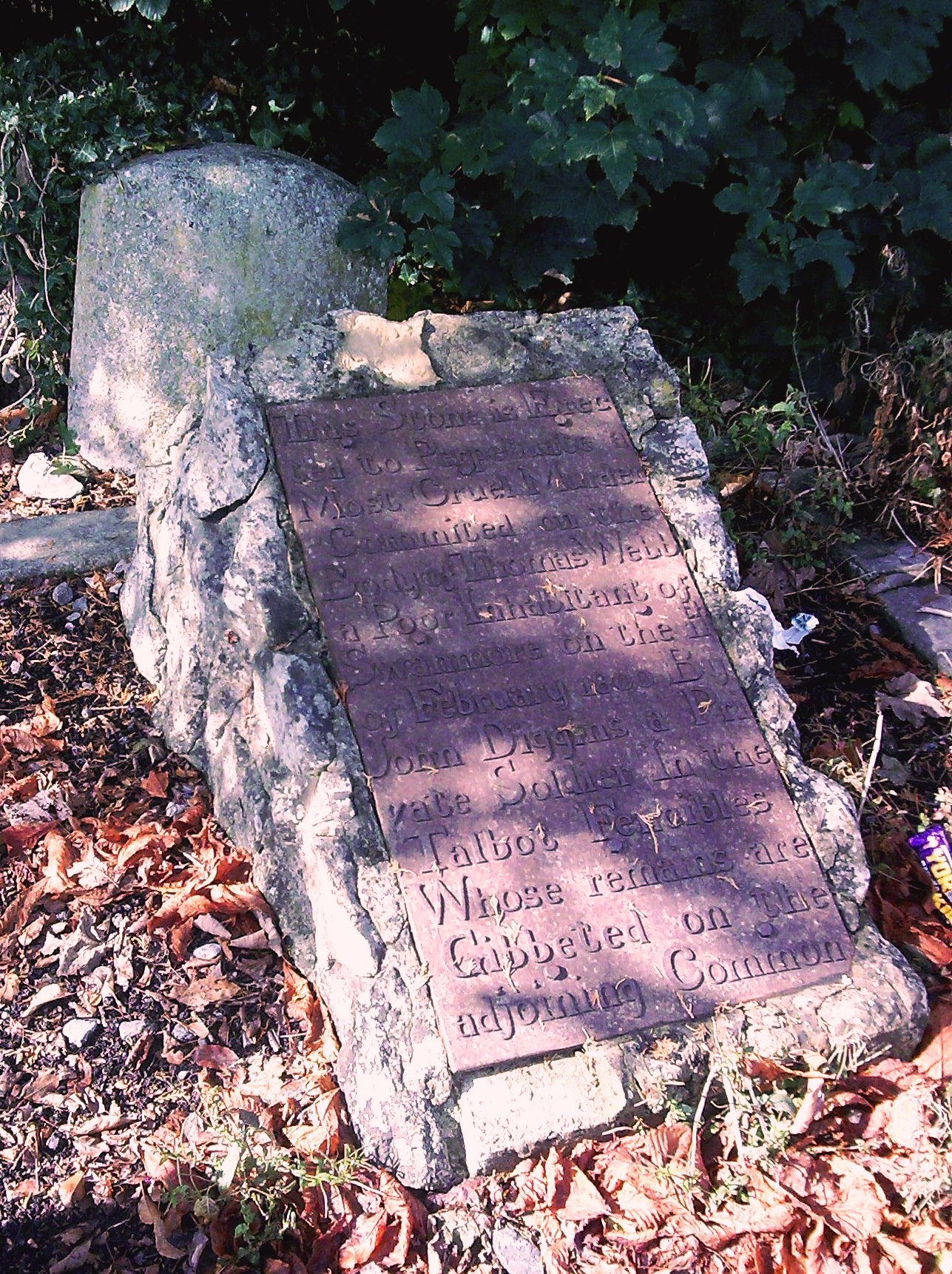
Murder memorial stone at Botley Station

Behind the Victorian Fountain at the entrance to Botley Railway Station (so called – it is of course in Curdridge) there is a cast iron plaque mounted on cemented stones :


It reads :

This Stone is Erected to Perpetuate a Most Cruel Murder Commited on the Body of Thomas Webb a Poor Inhabitant of Swanmore on the 11th of February 1800 By John Diggins a Private Soldier in the Talbot Fencibles Whose remains are Gibbited on the adjoining Common

The Talbot – or Tarbet – Fencibles were barracked in Botley at the time. Private Diggins, with two other soldiers, had come upon Thomas Webb, a poor and elderly pedlar, somewhere near Kings Corner (Pinkmead) in Curdridge. They not only robbed him of what few shillings he had, but then – according to a contemporary newspaper report – stabbed him, threw him in a ditch and stamped on him. Despite his injuries, Webb was able to crawl to a nearby cottage and get help – including the removal from his body of six inches of bayonet by a local surgeon. He was also able to tell what had happened – before he died. Diggins was found guilty of the murder at Winchester Assizes and sentenced to be hanged. The other two soldiers were acquitted for lack of evidence. Diggins was hanged in Winchester and his body then gibbited – that is, hung to rot – on Curdridge Common, between the main road to Shedfield and Outlands Lane. Thomas Webb was buried in St Peter’s Church graveyard, Bishops Waltham.

Meanwhile, the stone referred to on the plaque is not the cemented stones on which the plaque itself is mounted, but the undistinguished stone, without inscription, which sits half buried behind it. This suggests that the plaque was a later addition, Victorian perhaps, by when local history had became a subject of much interest.

All this can be found in more detail in local historian Dennis Stokes’ Botley and Curdridge – A history of two Hampshire villages, published by the Botley and Curdridge Local History Society (2007) – http://www.botley.com/history-society

I became curious about the plaque when I came upon the following:

Hampshire Treasures, Volume 1 ( Winchester City District), Page 82 – Curdridge

Memorial Stone Site of murder. Culprit hanged on local gibbet, cast iron plaque removed to Portsmouth City Museum.     SU 520 130
1904 27

How can the plaque have been ‘removed’ to Portsmouth and yet still be present in Curdridge ?

I wrote to the Museum about it. Their reply was :

“The original plaque was donated to the Portsmouth City Museum before 1945 & is kept in storage there, although it has been used in a display at Southsea Castle. The plaque at Botley Station, therefore, must be a copy.”

Our plaque a copy ? Why, that practically makes it a forgery !

Or, perhaps, for some reason, two copies of the plaque were made at the same time? But why ?

History, it seems, is full of mystery . . .

Still, if anyone knows anything more about this matter, do let me know.

*
Another account of the murder can be found at : https://georgianera.wordpress.com/2015/04/21/the-gruesome-murder-of-thomas-webb-1800-curdridge-hampshire/

*

And yet another, brought to my attention by Rob Jeffries (see below) :

The Cruise of the Land-Yacht “Wanderer”; or Thirteen Hundred Miles In My Caravan, by William Gordon Stables, London 1892.
Extract from Chapter Twenty Seven.

Botley is one of the quietest, quaintest, and most unsophisticated wee villages ever the Wanderer rolled into . . . My attention was attracted to a large iron-lettered slab that hangs on the wall of the coffee-room of the Dolphin. The following is the inscription thereon:—

This Stone is Erected To Perpetuate a

Most Cruel Murder Committed on the Body

of Thos. Webb a Poor Inhabitant of Swanmore

on the 11th of Feb. 1800 by John Diggins

a Private Soldier in the Talbot Fencibles

Whose Remains are Gibbeted on the Adjoining Common.

And there doubtless John Diggins‟ body swung, and there his bones bleached and rattled till they fell asunder.

But the strange part of the story now has to be told; they had hanged the wrong man!

It is an ugly story altogether. Thus: two men (Fencibles) were drinking at a public-house, and going homewards late made a vow to murder the first man they met. Cruelly did they keep this vow, for an old man they encountered was at once put to the bayonet. Before going away from the body, however, the soldier who had done the deed managed to exchange bayonets with Diggins. The blood-stained instrument was therefore found in his scabbard, and he was tried and hanged. The real murderer confessed his crime twenty-one years afterwards, when on his deathbed.

So much for the Botley of long ago.

The iron slab, by the way, was found in the cellar of the Dolphin, and the flag of the Talbot Fencibles, strange to say, was found in the roof.

Children’s Games – Eeny meeny miney moe, eeny meeny macka racka

Playground rhymes.

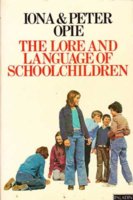
For anyone brought up in an English-speaking playground, the books of Iona and Peter Opie are not to be missed. Their subject is the world of children’s play – songs, games and rhymes found in street and playground, passed from child to child, a lost world, half remembered, mostly forgotten, and hardly noticed by much too busy and serious adults. The success of their first book – “The Lore and Language of Schoolchildren” (1959) – or perhaps just the pleasure of watching children play – set the Opies off on a lifetime’s career of observing, collecting and writing about children’s play.

I asked my eight-year-old daughter[1] what she and her friends sang or played together at school in the playground, but this was evidently not a sufficiently sensible or interesting question. “Games”, she said, “You know…” It was not until I gave her an example – from the Opie’s book “The Singing Game” – that she came up with the following:

My boyfriend gave me an apple
My boyfriend gave me a pear
My boyfriend gave me a kiss on the lips
And threw me down the stairs
I gave him back his apple
I gave him back his pear
I gave him back his kiss on the lips
And threw him down the stairs
I threw him over China
I threw him over Spain
I threw him over Australia
And never saw him again.

This is a song or chant for a clapping game. The girls (these singing games are mostly performed by girls) stand face to face and clap against each other’s and their own hands in a set pattern in time with the beat of the song – as my daughter demonstrated as best she could, having only an inexpert adult – myself – to clap with.

The song is part of what the Opies record as “I am a pretty Dutch Girl“, which, they say, seems to have arrived in Britain in about 1959 from America and then “spread through the country like wildfire”. Clapping games themselves are much older, with records from Britain and the United States over the last one hundred years and more, but they apparently enjoyed a revival in Britain in the 1960’s as this and other American songs arrived.

Another `song’ my daughter chanted was this :

I had a little brother
His name was Tiny Tim
I put him in the bath tub
To see if he could swim
He drank up all the water
He ate up all the soap
He tried to eat the bath tub
But it wouldn’t go down his throat
In came the Doctor, in came the Nurse
In came the lady with the alligator purse
`Measles’ said the Doctor, `Mumps’ said the Nurse
`Pizza’ said the lady with the alligator purse
Out went the Doctor, out went the Nurse
Out went the lady with the alligator purse.

The first eight lines are identified by the Opies as coming from an early twentieth century bawdy song and the remainder as a game-song of American children from at least the 1920s. There, however, they sang of “a big black purse”. Wherever it came from, the “alligator purse” is a fine improvement in rhythm, even if the meaning remains utterly mysterious. Meanwhile, Steve Roud, another excellent student of children’s games[2], provides a version of these last lines collected in London in 1907, only there, its not a lady that comes in, but the devil !

The only other clapping song my daughter came up with is recorded by the Opies under “Less Popular Clapping Songs” without comment (and without the curious first four lines):

In Bombay, in the land of Alaska,
Far away, in Bombay
Uncle Duffy is puffing his pipe
Puff puff, puff puff
All the girls in Spain
Wash their knickers in champagne
And the boys in France
Do the belly wobble dance
And the dance they do
Is enough to tie a shoe
And the shoe they tie
Is enough to tell a lie
And the lie they tell
Is enough to ring a bell
And the bell they ring
Goes : Dingalingaling!

Perhaps, like others, this had a bawdy origin somewhere, or maybe its just the result of childish wit and delight in language.

Another of my daughter’s rhymes ran :

I went to a Chinese restaurant
To buy a loaf of bread
I gave the man a five-pound note
And this is what he said:
“My – name – is
Hong Kong fuey
Diddle-aye-do-ee
Ice cream cornet
Fish and chips.”

Alternatively, the last four lines can go:

Elvis Presley
Girls are sexy
Sitting in the back seat
Drinking Pepsi
Having a baby
Calling it daisy
Come and join the fun fun fun!

These lines are obviously no older than the 1960’s and may be American. The first four lines – concerning a Chinese restaurant (or laundry) – are reported by the Opies from the 1950s, when they were often used as an introduction to a counting-out rhyme – that is, for de-selecting from a group until the last person becomes `it’ or `he’ or ‘on’, in a chasing game for example. In that guise the rhyme continued with whatever was the local and current form of “Chinese counting” – something along the lines of:

Eeny meeny macka racka
Ooray dominacker
Dominacker chikaracker
Om pom push!

I ‘invented’ that one. There are hundreds like it, more or less similar, and that is my half-remembered and approximate version of what we chanted many years ago. I have the feeling that there was a “lollipopper” in there somewhere too[3].  A female friend who was at primary school in Middlesex in the early to mid nineteen-sixties remembered it without a moment’s hesitation, and with the lollipopper too:

Eeny meeny macka racka
Rare-rye dominacker
Chickenpokker lollippopper
Om pom push!

Another (male) friend, who was at primary school in southern Hampshire in the early nineteen seventies, also knew it – but not to recite, because it had been strictly a girl’s rhyme, which they used in skipping games. So too my male, eighty year-old neighbour who was brought up in Woolston (Southampton) in the 1930s/early 1940s, who only knew it by repute and not to recite : “it was a girl’s game”.

My daughter had never heard of anything like it. She had heard of “Eeny meeny miney mo”, but she didn’t know how it went after that – which is, perhaps, an indication of some success in efforts to change old attitudes – as is the fact that among those who do know it the offending word has now been replaced by ‘tiger’, ‘tigger’ or similar.

In “Children’s Games in Street and Playground” (1969) the Opies conclude that while the Eeny meeny macka racka ‘gibberish’ rhyme itself is of no great antiquity (they found no records of it before the 1920s), its origins and those of similar rhymes – especially those beginning Inty minti, Eenty teenty or Zeenty teenty instead – are old – possibly very old. The connection has been made between at least some of these rhymes and the “Shepherd’s Score”, a traditional way of counting sheep, fish, stitches, and so on, in a number of counties in the north of England. The Opies found children in Keswick (in Cumbria) still using this method in their counting out. The Shepherd’s Score in turn has been traced, speculatively, to medieval welsh drovers; to still more ancient Celts driven to the hills by invading Anglo-Saxons; or, as the Opies prefer, to the ancient British tongue of Cumbria.

This seems an ambitious claim at first glance, until you get to numbers three and four in the Shepherd’s Score. Here is the beginning of a counting-out rhyme from Edinburgh (for some reason Scotland seems to be particularly rich in this form of the rhyme) : Inty, tinty, tethery, methery [4]. Here are the first four numbers of the traditional counting system used by the children from Keswick : Yan, Tan, Tethera, Methera – which is identical to the Shepherd’s Score reported, for example, from the Derbyshire Dales, and very similar to those from elsewhere [5]. The similarity of these otherwise peculiar and unfamiliar words is striking. And there are more. The earliest of this family of rhymes found by the Opies is this from 1820 :

                Zinty, tinti
                Tethera, methera
                Bumfa, litera
               Hover, dover
               Dicket, dicket
               . . . [6]

The Shepherd’s Score, meanwhile, includes bunfit/bumfit (15), lethera (7), hothera (8), dovera (9) and dick/dik (10)[7]. Also noteworthy is that both the Shepherd’s Score and the gibberish rhyme words for five are usually something starting with a plosive ‘p’, such as pimp or pump or push. As the Opies note, the Shepherd’s Score seems to be the ‘starting point, or inspiration, or source of occasional words’ of various versions of the children’s rhyme.  However, while a connection between the Shepherd’s Score and some versions of counting- out rhymes does not seem to have been entirely dismissed, the idea that the Score itself is of a great vintage is no longer respectable. Steve Roud summarises the scholarly situation thus :

‘Unfortunately . . . there is no evidence to support the assumption that the ‘shepherd’s score’ is of great age. The earliest mention of it in Britain is about 1745. In fact, in the opinion of many post-war experts, internal linguistic evidence, such as these numeral’s affinity with modern rather than old Welsh, demonstrates that they were introduced into the areas they were found a great deal later than the period of Anglo-Saxon settlement.’ [8]

In other words (I think), the Score probably arrived with modern Welsh speakers moving into England during the 18th Century.

Roud’s scepticism, meanwhile, is well trumped by Michael Barry[9]. In frustration at the unknowability of the origins of the Shepherd’s Score, he very nearly argues that it was only after folklorists started collecting and disseminating versions of the Score that they began to be known, but only ever second-hand and by repute. That is, no one is ever found who actually uses such a Score – for counting sheep, stitches, fish, or whatever ![10]

Roud’s summary of the scholarly situation is disappointing of course. However, while I am not qualified to comment on the linguistic evidence, I am not convinced that the lack of mention before 1745 is a clincher. A great deal of folk culture was not recorded before 1745. In fact most of what we know was not written down until the nineteenth century when collecting folklore and customs became fashionable.

Similarly, Roud also seems to suggest that counting-out rhymes are not so old either, on the grounds that the earliest recorded example is from 1759 (or possibly 1611 in France)[11]. On the one hand, the fact that childhood was, for most, a very different experience before formal education arrived – lots of work and no ‘rithmatic – could support Roud’s suggestion. But on the other, to suggest that children neither played together nor knew how to count even to five before the eighteenth century seems unlikely. It seems to me much more likely that we simply have no records.

But to return to the ‘gibberish rhyme’, these examples are from an on-line exchange on Mudcat.org :[12]

From Salford in the 1930s, where my mum lived as a girl, and passed on to me.

Eeny meeny mackeracka
Rare eye dummeracka
Chickeracka rare eye
Om pom push

My great uncle Albert who lived from 1902-1979 used to tell me

Eeni meeni mackeraca er rye dominacka chicka packa lullapacka rum pum push

From my nan born in 1920s west London

Eeny meeny mackaracka
Rare rye dominacka
Chickalacka lollipoppa
Om Pom push

These examples support the Opie’s report that they could not find examples of the ‘gibberish rhyme’ before the 1920s. However, it depends what you’re looking for. They specifically say that ‘Eenie, meenie, macca, racka’ was not known to Bolton, the author of one of the first collections of children’s counting-out rhymes, in 1888. But the following was known to Bolton :

Eenie, Meenie, Tipsy, toe;
Olla bolla Domino,
Okka, Pokka dominocha,
Hy! Pon! Tush![13]

It is clearly the `same’ rhyme, even though it lacks the macka racka. So the ‘gibberish’ is at least as old as the 1880s.[14]

Eeny meeny miny moe.

Historically speaking, the most well-known version of the eeny meeny family of rhymes is probably :

Eeny meeny miny moe
Catch a n—– by his toe
If he hollers let him go
Eeny meeny miney moe

As noted earlier, the offensive word has been replaced over time by tiger or tigger, or some-such. This seems to have happened during the 50s in the States and in the 70s in the UK, presumably reflecting the advance of awareness of racism in each country. Meanwhile, the rhyme is first reported from the late 19th Century, by Bolton again, who suggested that it probably originated in America. [15] The Opies agree, given the vocabulary.

There is also a theory that the original origin of “Eeny meeny miny moe” and possibly of the mention of a black person too, is from the Portugese/West African Creole language of the islands of São Tomé and Principe, which lie off the West coast of equatorial Africa. The language is known as São Tomense. [16] Derek Bickerton notes the following: in São Tomense, ine is used to turn the next word into a plural; the next word (of the rhyme) is mina, which means child – therefore, children. Meanwhile, mana means sister and mu means my. In other words, ine mina mana mu is São Tomense for my sister’s children !  Bickerton also notes, in support of the theory, that we have a children’s rhyme on the one hand and a reference to children on the other; a reference to a black person in the rhyme and a language spoken by black people – presumably including at least some black slaves in 18th or early 19th Century America. He then suggests that, somewhere in the US, children already familiar with Score-derived counting-out rhymes heard the São Tomense expression, noticed the resemblance and proceeded to incorporate the new words into a counting-out rhyme. He also confesses that he has no evidence to back this history up, but concludes that an Afro-Creole source for eeeny meeny miney mo `would seem to be at least as convincing as a Celtic one.’

Or possibly not. The only other writer I can find picking up on this theory is the Carribbean poet, novelist, and local creole language advocate, Frank Martinus Arion. Arion is from the Dutch Antilles, and his topic is a creole known as Guene. Having repeated Bickerton’s analysis of the São Tomense expression (without acknowledgement), and noting that a creole word maina means to quiet down, he concludes that the real meaning of the eeny meeny rhyme is in fact : “Children quiet down/You have to go to bed now/It is finished. Look at this whip” ! This would have been used by a – probably black – nanny to the children in her charge. [17]

And that is not all. Arion is a Dutch speaker. According to a Dutch contributor to the Mudcat.org thread mentioned above, he also discusses the well know Dutch version of the eeny meeny rhyme, also used for counting-out.[18] It goes like this :

Iene miene mutte      [ Eena meena mutte
Tien pond grutten       Ten pounds of groats
Tien pond kaas            Ten pounds of cheese
Iene miene mutte       Eena meena mutte
Is de baas
             Is the boss]        

Arion then reports a creole – probably São Tomense – song, sung by black slaves, which goes (or went) like this :

Iene miene muito      
Tempo de n’grutta
Tempo de n’kasala
Iene miene muito
Es de baixe.

Arion’s analysis of this rhyme goes like this: Iene is a pluralizer; miene is from the Portuguese word for girl, menina; muito is the Portuguese word for much/ many; tempo means time; n’grutta means to make love; kasala comes from the Portuguese casar se, to marry; baixa is the Portuguese word for down or below.  So the translation of the song into English would be :

Many girls.         
Time to make love
Time to marry
Many girls
Down there below.

Male slaves were put on the upper decks, the women below on the lower decks.

One has to note that as an advocate for the contribution of West African-origin creoles to Western culture, Arion’s arguments may be somewhat motivated.

Nonetheless, it’s a great story.

Eeny meeny . . .

It is time now to return to basics, that is, to eeny and meeny. Whatever contribution Shepherd’s Scores or West African slaves may or may not have made to the eeny meeny family of rhymes, it is noteworthy that a great many of the rhymes begin with these two words, or versions thereof. And It is also the case that these rhymes are usually used by children for counting-out. As we have seen from the Dutch example above, the rhyme is not confined to English speakers, and similar beginnings are to be found in German (including by Bolton), Danish, Norwegian and elsewhere[19].

It is clear enough that eeny is simply a version of one – een in Dutch, ein in German, aan in old English, eena in a Shepherd’s Score from North Yorkshire[20], oan in Scottish Gaelic, un in Welsh. The addition of the y, that is, the ee sound, would then be just a bit of fun, playing with sounds, as in the more obvious onery, twoery way of counting (which was the most common way in Bolton’s day). Meeny would then be simply a fun rhyme to follow.  But we can go on : miney and mo alliterate with meeny; similarly, the  n occupies the same position and internally alliterates in eeny, meeny and miney ; the vowels go ee i o, which form a natural series produced from the front to the back of the mouth (as in fee, fi, fo fum, or ee eye o). David Rubin and colleagues point out these and other structural-linguistic features to explain how children manage to remember these rhymes.[21] My point is that they also help to explain why they are so popular and persistent. The fact is, they are fun !

It seems reasonable to conclude that the eeny meeny family of rhymes may have multiple sources. It certainly has multiple traditions and perhaps multiple occasions of semi-independent invention, when the need for a means of counting-out was (and is) required. Above all, it is the result of generations of children in countless playgrounds delighting in playing with the musicality of language – and with nonsense.

*

While counting-out rhymes are common to both boys and girls, clapping games and their songs, as mentioned above, are generally girls’ games. Perhaps that’s why I recognised none of the songs in the Opie’s singing games book, and none of my daughter’s. One game we used to play, however, was for the boys only – the utterly serious game of flick cards . . .


  1. This was in 1994. She had attended Ridgemead Primary School, Bishops Waltham, in Hampshire, England. ↑

  2. Roud, Steve The Lore of the Playground: One hundred years of children’s games, rhymes and traditions, Random House, London, 2010, p169 ↑

  3. I was at Eastwick Primary School, Great Bookham, Surrey, England, from 1960 to 1966. ↑

  4. http://www.electricscotland.com/kids/bairns/page2.htm ↑

  5. https://en.wikipedia.org/wiki/Yan_tan_tethera ↑

  6. ‘The Chatterings of the Pica’, Charles Taylor,1820, described as being old. ↑

  7. http://stancarey.wordpress.com/2013/11/27/yan-tan-tethera-pethera-pimp-an-old-system-for-counting-sheep/ ↑

  8. Roud, Steve The Lore of the Playground: One hundred years of children’s games, rhymes and traditions, Random House, London, 2010, p354. NOTE : I began this piece recommending the Opies’ work. I would now also recommend Steve Roud’s book, which is much shorter and covers everything you need to know. ↑

  9. Traditional Enumeration in the North Country, Michael Barry, Folk Life, Volume 7, Issue 1 (01 January 1969), pp. 75-91 ↑

  10. See also : Major and Minor Chronotopes in a Specialized Counting System, Donald N Anderson, Journal of Linguistic Anthropology, Vol. 21, Issue 1, pp. 124–141, ISSN 1055-1360, EISSN 1548-1395. © 2011 by the American Anthropological Association. https://www.academia.edu/948046/Major_and_Minor_Chronotopes_in_a_Specialized_Counting_System ↑

  11. Roud, ibid ↑

  12. http://mudcat.org/thread.cfm?threadid=47148#701914 ↑

  13. Bolton, Henry Carrington, The Counting-out Rhymes of Children: Their Antiquity, Origin, and Wide Distribution. New York: D. Appleton & Co. (1888). ↑

  14. Incidentally, as I recall, we used parts of the rhyme as a rousing chant in Cubs/Scouts in the 1960s – led by adults – much in the manner of the contemporary All Blacks’ Maori-style chant:

    Dominakka chikkarakka, Dominakka chikkarakka, Dominakka chikkarakkaOm pom push ! ↑

  15. See http://en.wikipedia.org/wiki/Eeny,_meeny,_miny,_moe ↑

  16. An Afro-Creole Origin for Eena meena Mina Mo, Derek Bikerton, American Speech, Vol. 57, No. 3 (Autumn 1982), Duke University Press. www.jstor.org/stable/454870; p227 ↑

  17. The value of Guene for folklore and literary culture, Frank Martinus Arion, in A History of Literature in the Caribbean: English- and Dutch-speaking countries, Albert James Arnold, Julio Rodríguez-Luis, J. Michael Dash, John Benjamins Publishing, Jan 1, 2001, p 415-419 ↑

  18. My research became complicated here. The Mudcat.org contributor gives no reference other than to say she found the information on Wikipedia. I have been unable to do so, even in the Dutch version. Meanwhile it is possible that the material is to be found in the Arion paper referenced immediately above. However, I do not have access to the complete paper to confirm this. ↑

  19. Opies 1969 ↑

  20. http://www.yorkshiredialect.com/celtlang.htm ↑

  21. Children’s memory for counting-out rhymes: A cross-language comparison, David C Rubin, Violeta Ciobanu, William Langston, Psychonomic Bulletin and Review 1997, 4(3). 421-424 ↑


Flick cards

By the early 1960s, cigarette cards had long gone – ended by the austerities of the War – but tea cards had replaced them. The games that my father used to play with cigarette cards, we learned to play from our older schoolmates with the new tea cards – or, more correctly, trade cards. We collected them avidly, and won and lost great fortunes daily playing the game of flick cards.

Two boys (only boys) would stand some eight feet or so from a playground wall, each armed with a handful of cards. A card was held between two fingers and then launched towards the wall, by each player in turn, by means of a quick flick of the wrist. There were two versions of the game. The object of one was to get your card to land on another already lying on the ground. The first player to achieve this won all the cards previously thrown. In the other – known as ‘Death’ – the aim was to knock down two or more cards that had been lent against the wall. The player that toppled the last card was the winner and, again, took all the cards already thrown.

‘Death’ called for accuracy and a strong wrist, but in terms of rules was uncomplicated. In the other game, however, as with many children’s games, the simple scenario of the one card landing on another was qualified by a number of arcane requirements. Should a card overlap another by only its merest edge – defined by the thin white border surrounding the card’s illustration – this was called “tipses” and did not count. All ambiguous overlaps were anxiously examined at close quarters. If necessary, spectators would adjudicate. If the case was judged to be “tipses” the game continued. Should a card stall in mid flight and flutter down onto another, this was called “flutters” and was also invalid. So too was “undies”, where a card slid beneath another on landing. With these rules, vast numbers of cards could accumulate, and tension intensify, before at last the prize was won.

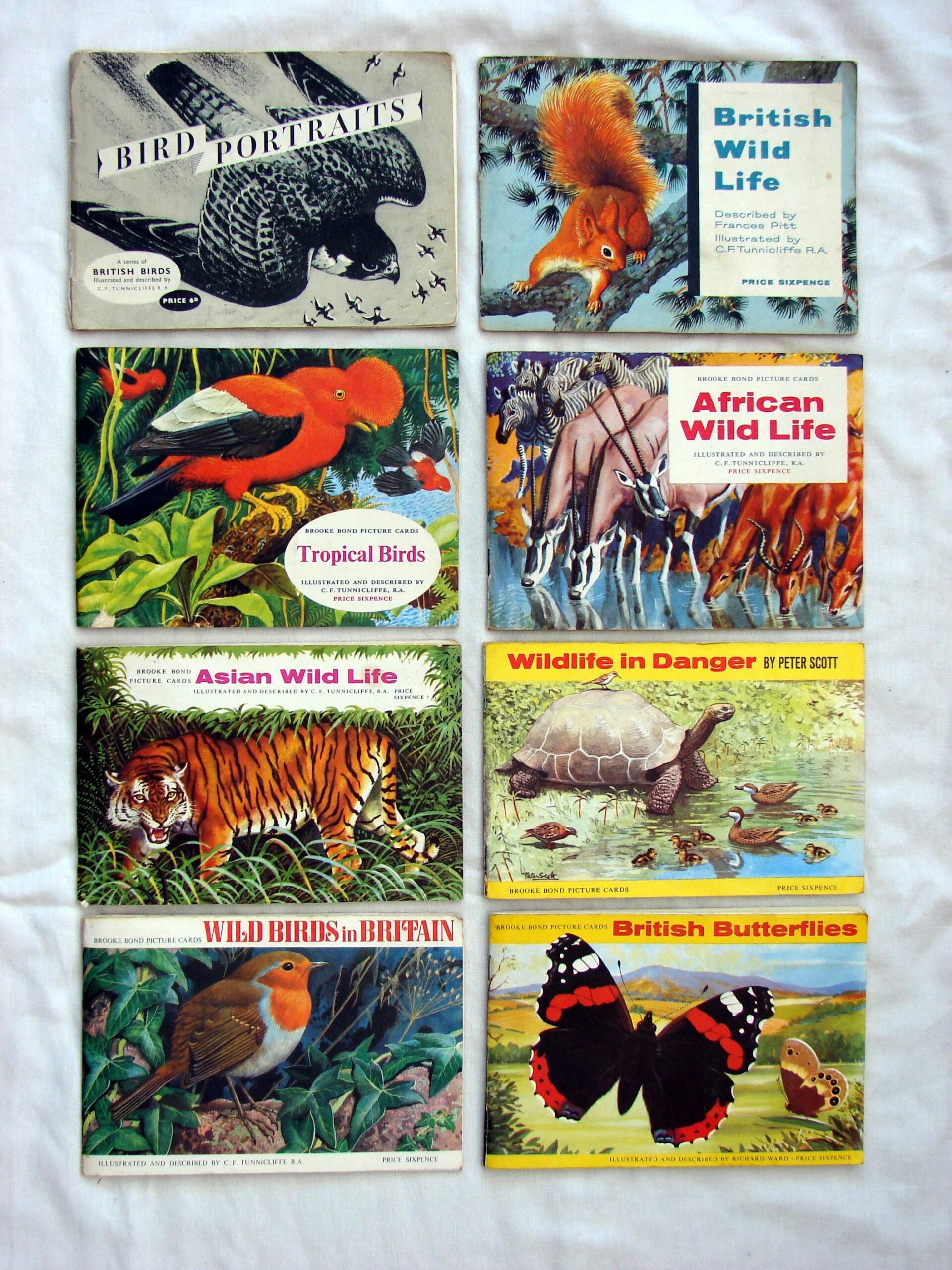
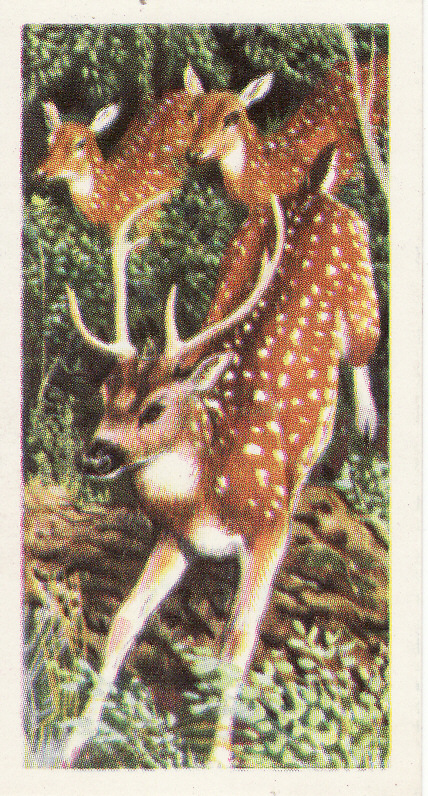
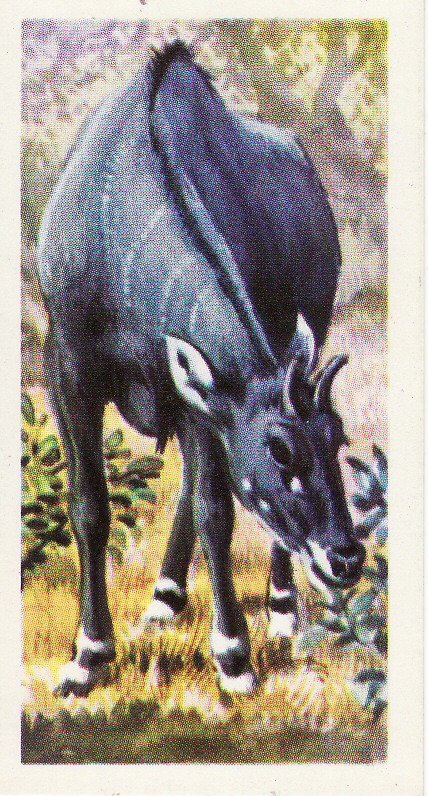
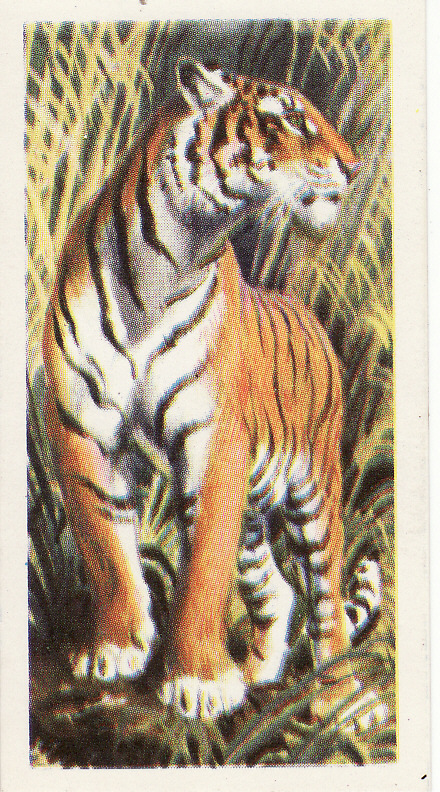
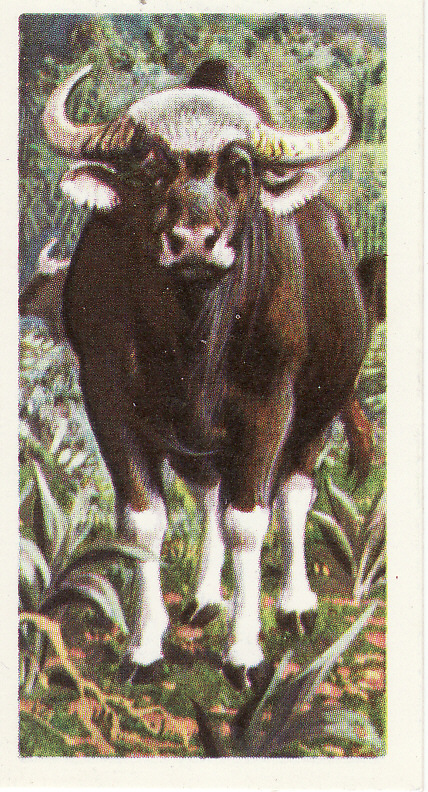
These tea cards were issued by a range of companies but circulation was dominated by Brooke Bond. At that time, their cards were almost wholly devoted to wildlife subjects. They began in 1954 with “British Birds” and thereafter produced a series or two each year, covering birds, wild flowers, butterflies, fish and animals from Britain and across the world. By the time we started collecting, probably in 1963 or ‘64, cards from the very first series were hardly to be found – occasional and somewhat mysterious relics of some ancient past. However, subsequent sets were still in circulation and new sets kept arriving, providing fodder for our boyish kleptomania as well as for our effortlessly assimilative young minds.

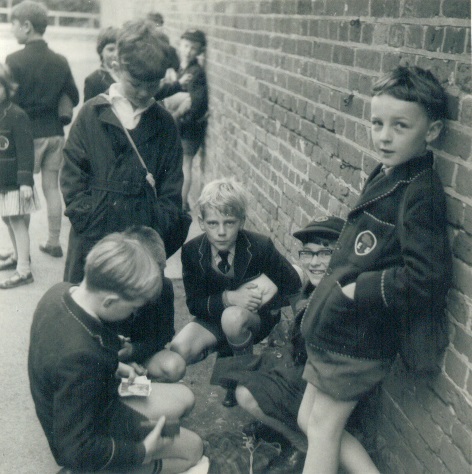
Card swapping, Eastwick Primary School, Great Bookham, Surrey, 1966.

I inherited an interest in wildlife from my parents, but there is  no doubt that Brooke Bond’s tea cards fed that interest and caused it to grow and become knowledgeable. By the age of ten I not only knew my British birds – those illustrated in “Bird Portraits” (1957) and “Wild Birds in Britain” (1965) at any rate – and my butterflies (“British Butterflies”, 1963) and wild animals (“British Widllife”, 1958) – but I was also familiar with the wild animals of Africa and Asia (“African Wildlife”, 1961; “Asian wildlife”, 1962), exotic birds (“Tropical Birds”, 1961) and endangered species from across the world (“Wildlife in Danger”, 1963).

All these sets were explicitly “issued in the interests of education”, according to the backs of the albums in which we stuck them, and they clearly served their intended purpose. It’s a pity then that although Brooke Bond continued to issue picture cards, they later stooped to trivia – cartoon turtles for example, or anthropormorphised chimpanzees – offered, presumably, in the interests of increasing sales.

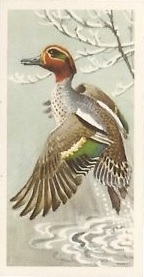
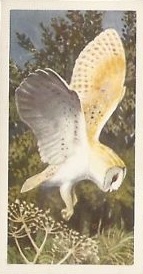
To be fair, Brooke Bond continued to return to wildlife subjects, and to other educational topics, including in collaboration with the World Wildlife Fund, as they first did with “Wildlife in Danger”. What they did not do, however, was to maintain the pictorial quality of the earlier sets, a feature which was at least as important as the information they conveyed in catching and keeping our interest. Between 1957 and 1966 those early sets were more often than not illustrated by C.F. Tunicliffe, whose both naturalistic and visually attractive style of painting was perfect for our unsophisticated eye – and our desire for facts. Some of his illustrations still rank among the finest examples of wildlife art, those for “Bird Portraits” in particular – the teal leaping from the water; the house sparrow in flight; the barn owl floating cream and white against the dusk :


Tunicliffe’s work seems to have established a house style during those years, so that when other artists were brought in – EV Petts for “Freshwater Fish” (1960); Richard Ward for two butterfly series (“British Butterflies”, 1963 and “Butterflies of the World”, 1964) – the cards remained instantly recognisable as coming from Brooke Bond.

*

I rediscovered how much I had learnt as a child, how many animals and birds had become familiar to me through collecting Brooke Bond’s tea cards, many years later. I was living in South India and I went with a friend to visit the Periyar Wildlife Sanctuary in the southern state of Kerala. The Sanctuary is set in the forests of the great chain of the Western Ghat mountains, centred around a long and many fingered lake created by the damming of the Periyar River.

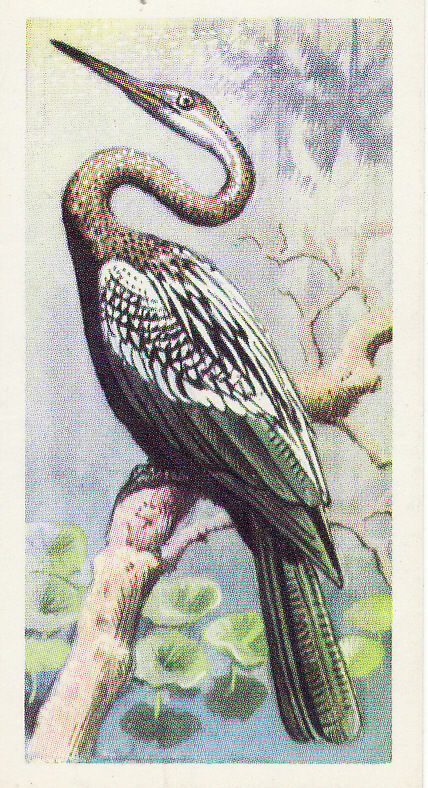
We rode up into the hills by bus and then walked from the village into the reserve. The narrow road ran between thick forest on one side and the lake on the other. In the water, or perched on grey stumps of drowned trees with wings held wide to dry in the sun, were thin, cormorant-like birds. I knew at once that they were darters (“Tropical Birds”, 1961). They are not the most beautiful of birds – snakelike, ragged, prehistoric – but they were old familiars and a thrill to see for the first time in the feather.

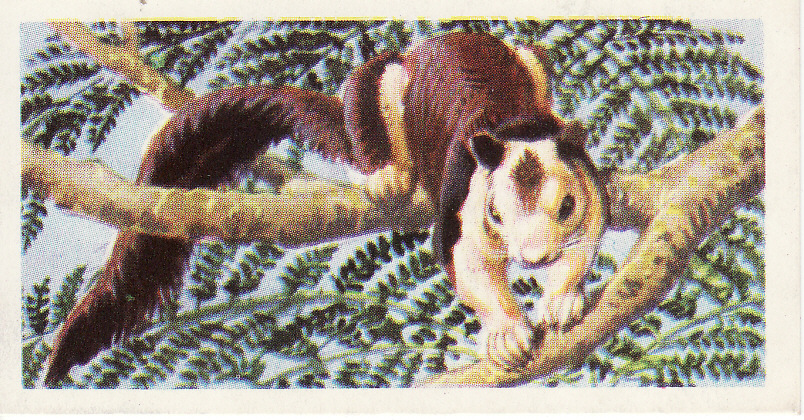
Shortly afterwards I spotted an animal moving in the trees above us, a brown, cream and enormous squirrel – the Indian Giant Squirrel (“Asian Wildlife”, 1962) – providing for a moment an almost exact image of Tunicliffe’s illustration, before it turned and made off, heavily, through the foliage.

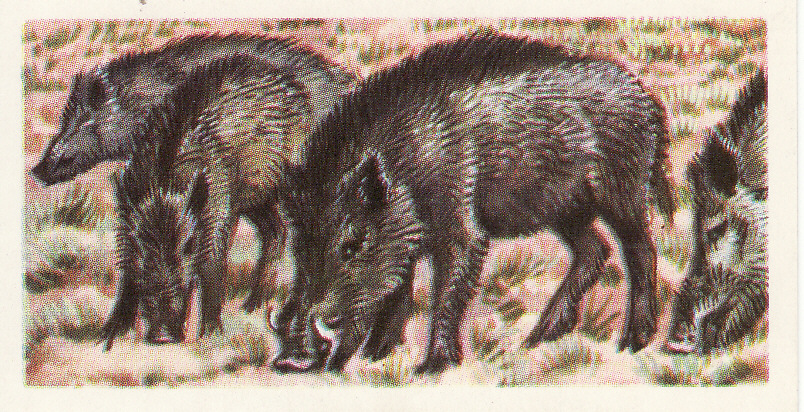
A few yards further on a herd of wild pigs burst out of the long grass and hurried across the road, long snouted and round bellied – indistinguishable in fact from the domestic Indian pig which roots and wallows in every village ditch. However, these were wild and also familiar  from “Asian Wildlife”.


The next day we went out onto the lake in a motor launch, together with other visitors to the reserve, and my private adventure continued. There were many more darters, and more wild pigs along the shore. Then we spied a dark line of animals making their way slowly across a hillside, too distant for a satisfactory view even through my binoculars, but instantly recognised anyway. These were Gaur, the largest member of the ox family.

We could not have imagined a closer view of the wild elephants we came upon next. Seeing them at the edge of the lake, the helmsman brought the launch in close. While a huge bull led his herd unhurriedly away into the forest, two cows and a calf plunged into the water towards us. They stood knee deep – or in the case of the calf, up to its chin – and proceeded to threaten us by swaying their great heads and splashing on the water with their trunks, making their indignation at our intrusion  clear. Elephants, of course, are hardly unfamiliar even to those who have never collected Brook Bond tea cards. Nonetheless, the Asiatic Elephant is there among them.

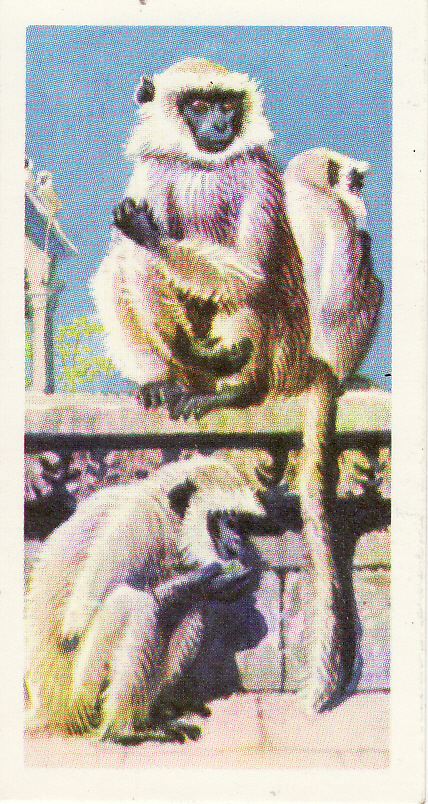
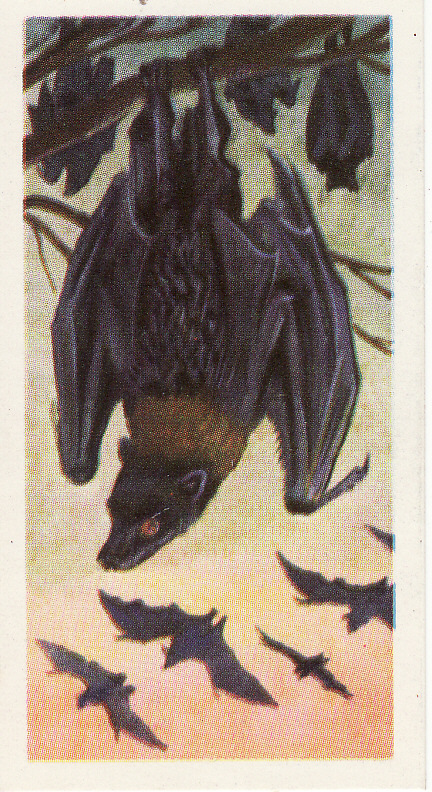
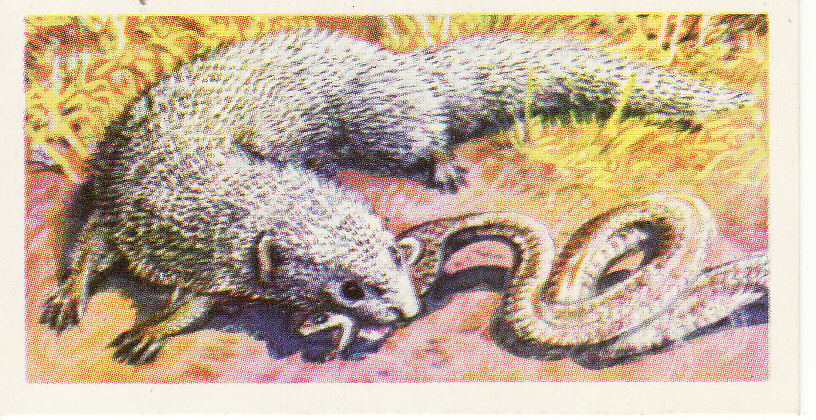
I have continued to meet old friends in the wild in India ever since: Chittal, or Spotted Deer; Nilgai antelope, or Blue Bull; a Tiger in the scrub forest of Ranthambore in Rajasthan; Blackbuck; a Gaur bull, huge and unhurried in the headlights of our jeep, in Andhra Pradesh; Hanuman Langurs, named after the monkey-god hero of the Hindu epic poem the Ramayana; Giant Fruit Bats hung like peculiar fruits by day or rowing soundlessly overhead at dusk; and Mongooses in a back garden in Madras city.


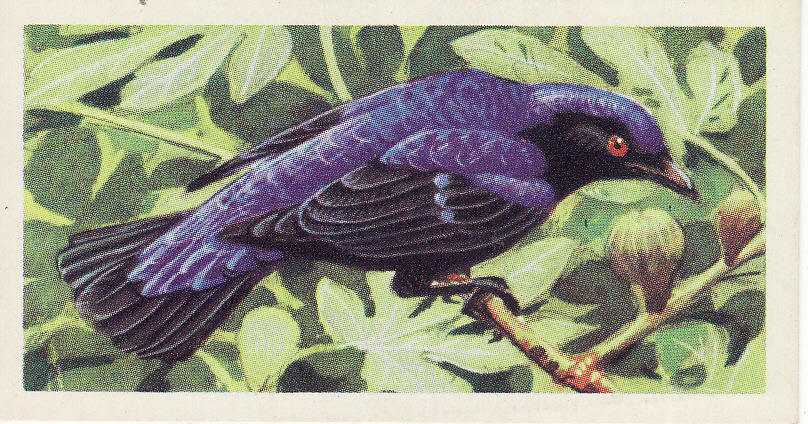
 Not only animals, but tropical birds as well: the fairy bluebird, the painted snipe and the orange (or scarlet) minivet, the males black and bright red, the females black and brilliant yellow.


I still have my collection of Brook Bond tea cards, won so many years ago, or bargained for “swops”. I add to it occasionally, when an album turns up in a charity shop or via e-bay.  And even now, here in the UK, there are a number of long familiar birds and animals which I have yet to meet – the Natterjack Toad, the Purple Emperor butterfly and the ring ouzel for example.  If and when I do happen upon them, I will, of course, recognise them at once with a very special delight.

*

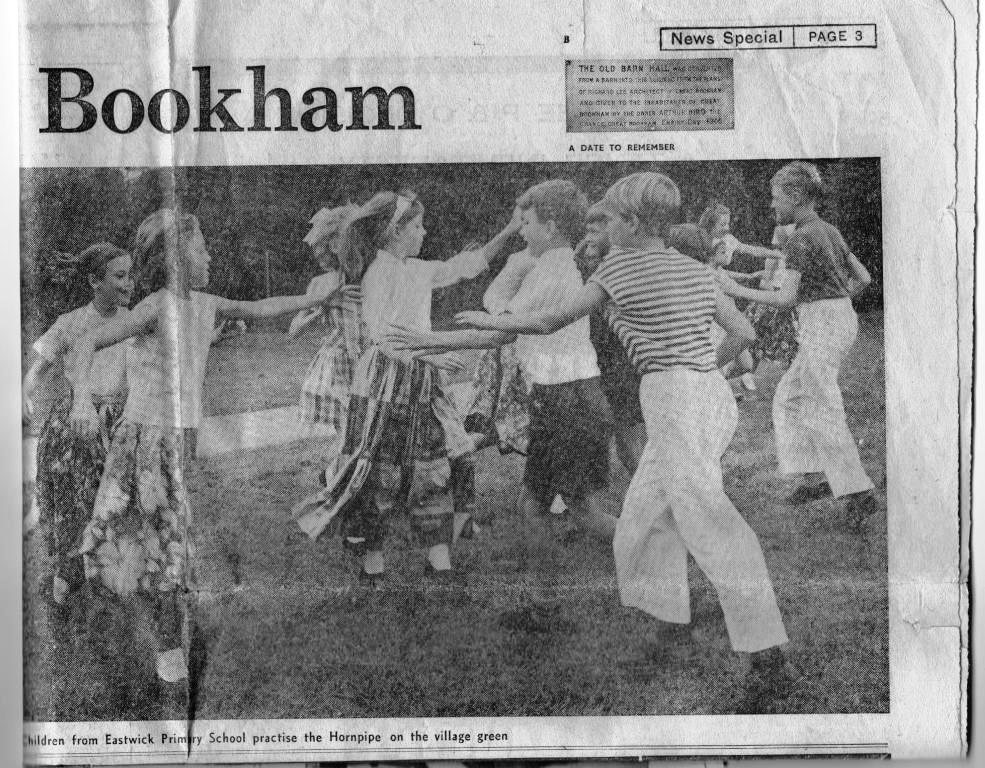
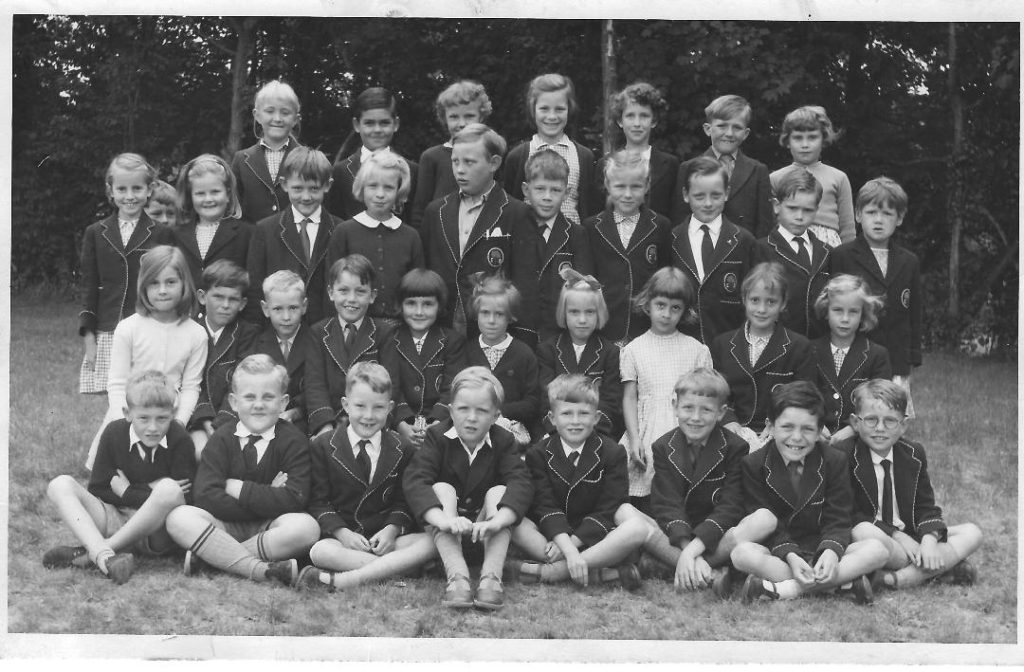
Eastwick Primary School, Great Bookham, Surrey, in the 1960s

Eastwick Badge   Hello Everybody –  Welcome to these Eastwick County Primary School pages. I was a pupil there from 1960 to ’66. This page is available as a home for photos and memories of those years.  For example :


(This was not my badge by the way)

Some of the photos here, and others, can also be found at :

https://www.leatherheadlocalhistory.org.uk/bookhamhistory/indexeastwickjs.html

Many thanks to the LLH for hosting this material, and to Ali Kelman who collected it in the first place and arranged for it to be transferred when the School web site no longer had a space for it.

If you have any photos or other material from Eastwick in the 1960s I would be happy to receive copies and post them here.

I would especially like to see any photos you may have from the photo project that was conducted in the first half of 1966 ( I think) by Mrs Harrowell, a part time teacher, as I recall, possibly incorrectly. 

Any comments you may have (as well as photos!) would be very welcome.

Kevan.

PS  These pages are growing and growing as I keep receiving communications from former Eastwickians, known and previously unknown.  Wonderful !

News !

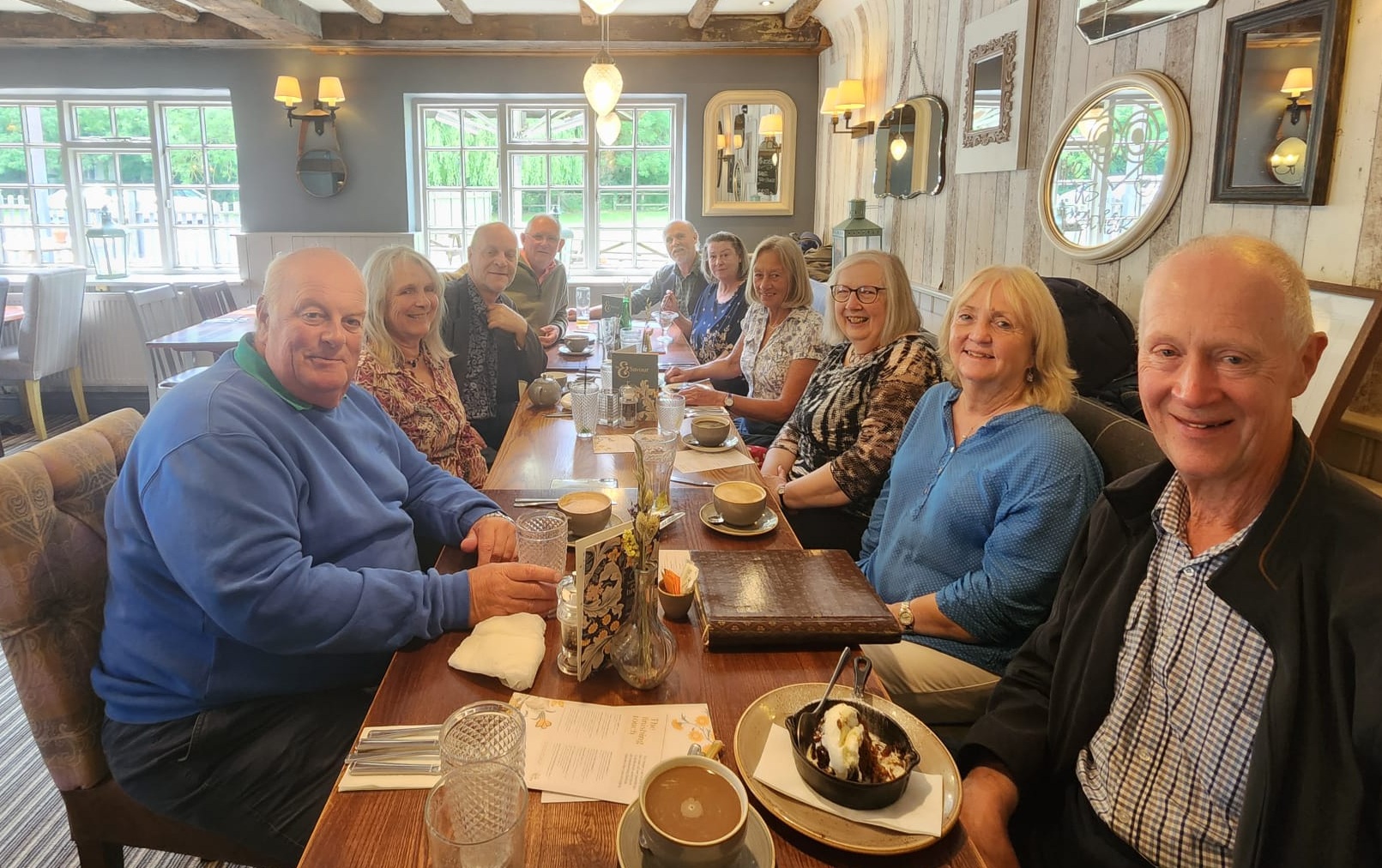
May 2025 – Another get-together at the Old Windsor Castle, Little Bookham.

Front right is our classmate Laurence (Laurie) Robinson – over from Australia where he has lived for many years.  His visit to the UK was a great excuse to get us all together again.  Laurie’s brother Mike is third down on the left.  Third down on the right is Diana (n.Baxter) who we were all meeting again for the first time.  Jess Perkins sits just beyond her.

Fifth on the right is Elaine Woodcraft (n. Baker), younger sister of our classmate Alan Baker.  Alan died  at the far too young age of 34.  We remembered him, his friendship – and his creative talents.  Bob remembered how Alan taught him how to use colour in his art work.  I remembered his skill at model building.  We used to cycle to school and back together.  We also played in the school football team together.


May 2023 – Eastwick Schools May Fair

Linda, Joy and I met up at Eastwick at the Spring Fair (Vasu came along with me as official photographer).  Unlike our last visit, we were not able to get inside – we could only peer through the windows.  We couldn’t even obtain access to the old playground.  The whole school is now surrounded by steel fencing and padlocked gates – to keep the children in I presume.  The Wall from the top of the field to the corner of the playground has gone, replaced by a curiously tall mesh fence.  The wall along the bottom of the playground remains, though reduced to half height.  It also sports a fine mural rather than painted wickets and circular targets.  The great redwood tree around which we once played remains, as you can see.  Joy and I recalled how we once concocted ‘perfume’ and ‘itching powder’ below it or in the crevices of its softly fissured bark.  I recalled that I once climbed to the top of it – when there was no one about to stop me.

Kevan


Hi everyone,

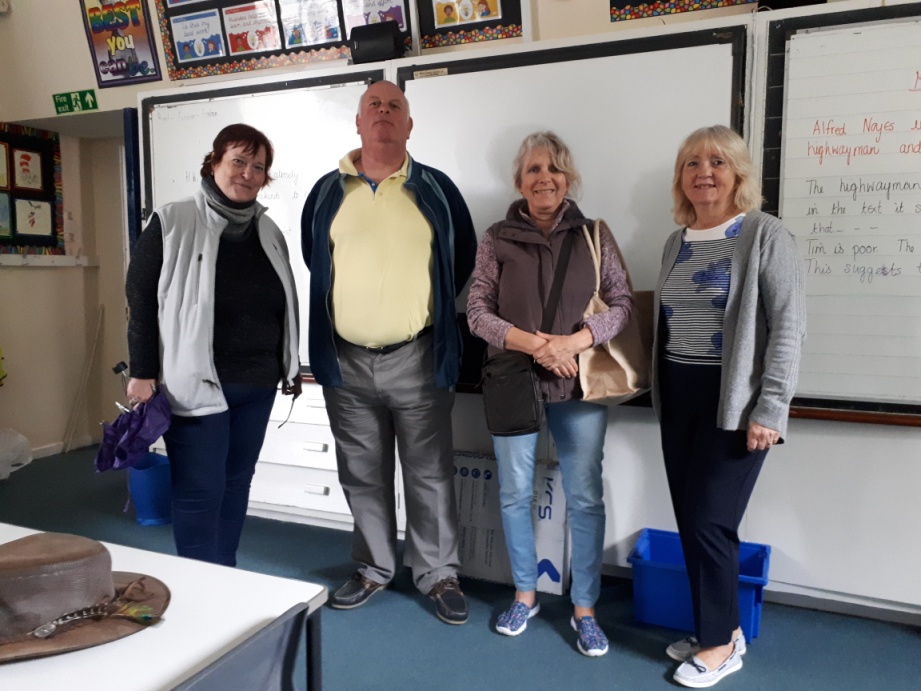
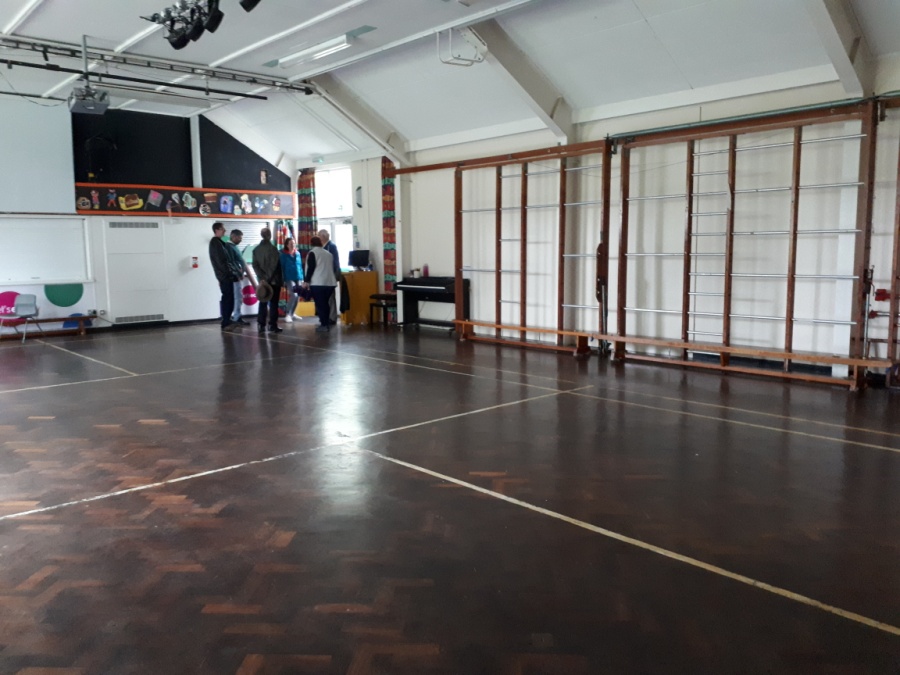
A few of us made it to the Fair [i.e. the Eastwick May fair 2018] and despite it raining from the moment we arrived it was an interesting visit.  We managed to have a look around inside and spent some time remembering classes and teachers.  We were pleased to see that the House names remain the same – although sadly the brick wall along the side of the field has gone and the playground has been built on – but I don’t expect they are allowed to play Kiss Chase now anyway!

All the best,

Joy xx

Eastwick 1 May 2018.jpg

Eastwick 2 May 2018.jpg

Eastwick 3 May 2018.jpg


*

Hi Everyone

Sorry I missed it, unavoidable, but see you next time. Very sad that ‘The Wall’ has gone. (Speaking of which, who knew that Roger Waters of Pink Floyd was born in Great Bookham – a bit before our time, in 1943?).

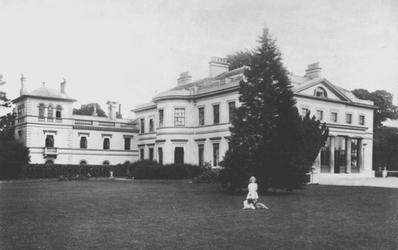
I’ve always been intrigued by the remnants of ‘the big house’ which existed before the school and found this pic:


C:\Users\Kevan\AppData\Local\Temp\image002.jpg

Wikipedia says “Eastwick Park, a beautiful manor in the village, was lost in 1958. The house stood within the area of roads now known as the ‘Eastwick area’, and its very large private estate included Great Bookham Commons, which were saved by the village and given to the National Trust. Since being used as a private house, the manor was used by Canadian military in the second world war, and was also a school called Southey Hall, before being demolished for redevelopment. The original gates to the house stand just west of Eastwick Park Avenue on Lower Road.” I recall my dad saying how the Canadian army used the school as a training ground and how they trashed the house so badly it had to be demolished.

Another page says “Eastwick Park was built by the French Huguenot architect Nicholas Dubois (c. 1665–1735) between 1726 and 1728 for Sir Conyers Darcy and his wife,[1] Elizabeth, daughter of John Rotherham of Much Waltham, Essex and the recent widow of Thomas Howard, 6th Lord Howard of Effingham.[2] In 1801 James Lawrell bought Eastwick Park from Richard Howard, the 4th and last Earl of Effingham (of the first creation). Eastwick Park then passed through a number of different owners before housing Southey Hall Boys Preparatory School from 1924 until 1954 (during World War II the boys were evacuated to Devon and Eastwick Park was turned into accommodation for Canadian soldiers). The house was empty from 1954 until 1958 when was demolished to make way for housing and Eastwick County Primary School (which has since been renamed Eastwick Junior School).”

In our time I remember a couple of boys found live-round bullets and a few years earlier someone found a live hand-grenade. Who remembers the black timber shed on the way to the old farmer’s place? Apart from the wall, I think all that remains of the original park estate is the brick stable block (used to be our sports changing rooms, horrid and cold) and any exotic trees that still survive.

Cheers

Bob

*

A 1966 class reunion was held on the 16th September 2017 at the Windsor Castle pub in Little Bookham.  Joy Spencer/Taylor, Linda Davies/Scrase,  Martin Claytor, Bob Medland, Chris Scriven,  Ian White and Kevan Bundell attended.  Jessica Perkins couldn’t make it, but sent her greetings.

Miss Bayley, and others, were fondly remembered.  Photos were perused and people identified (see below).  The contents of Kevan’s and Bob’s News Books were amusingly shared.   We all had a jolly good time.

We vowed to gather again at the next Eastwick School Fête/Fair in 2018.  We also agreed to track down other classmates and invite them to join us there.  If you are one of them, do send me an e-mail.  We would all love to see you again.

Kevan  –  kbundell@yahoo.co.uk


1965/6


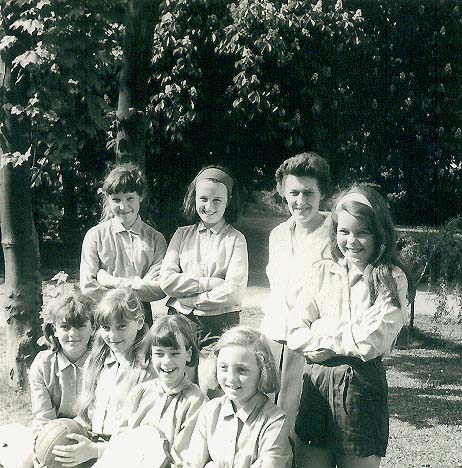
The Netball Team
Front : Suzanne Western, Hazel Smulders, Jaquie Russell-Bates, Linda Davies
Back :  Elizabeth Dalgairns, Joanna Woods, Mrs Cole (Coach and School Secretary), Lesley Rice


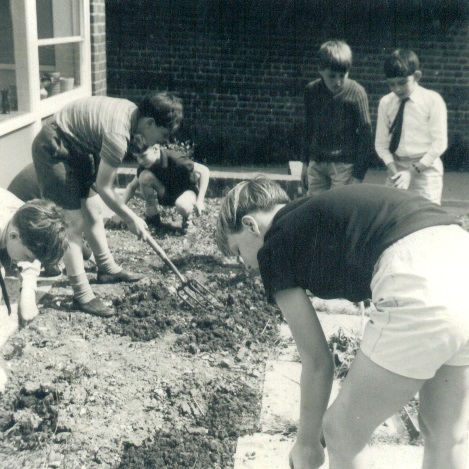
Gardening
l to r :  Kevan Bundell, Ian White, Roger Doswell, Martin Claytor,
Gregory Able, Robbie Medland


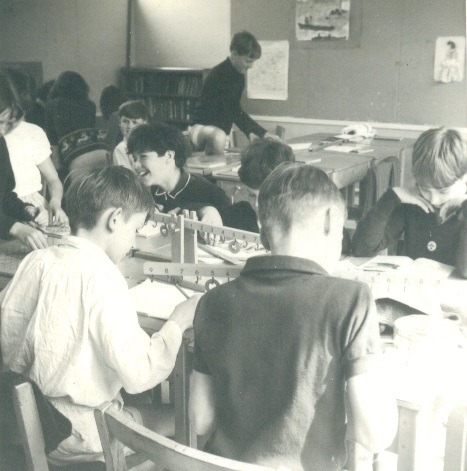
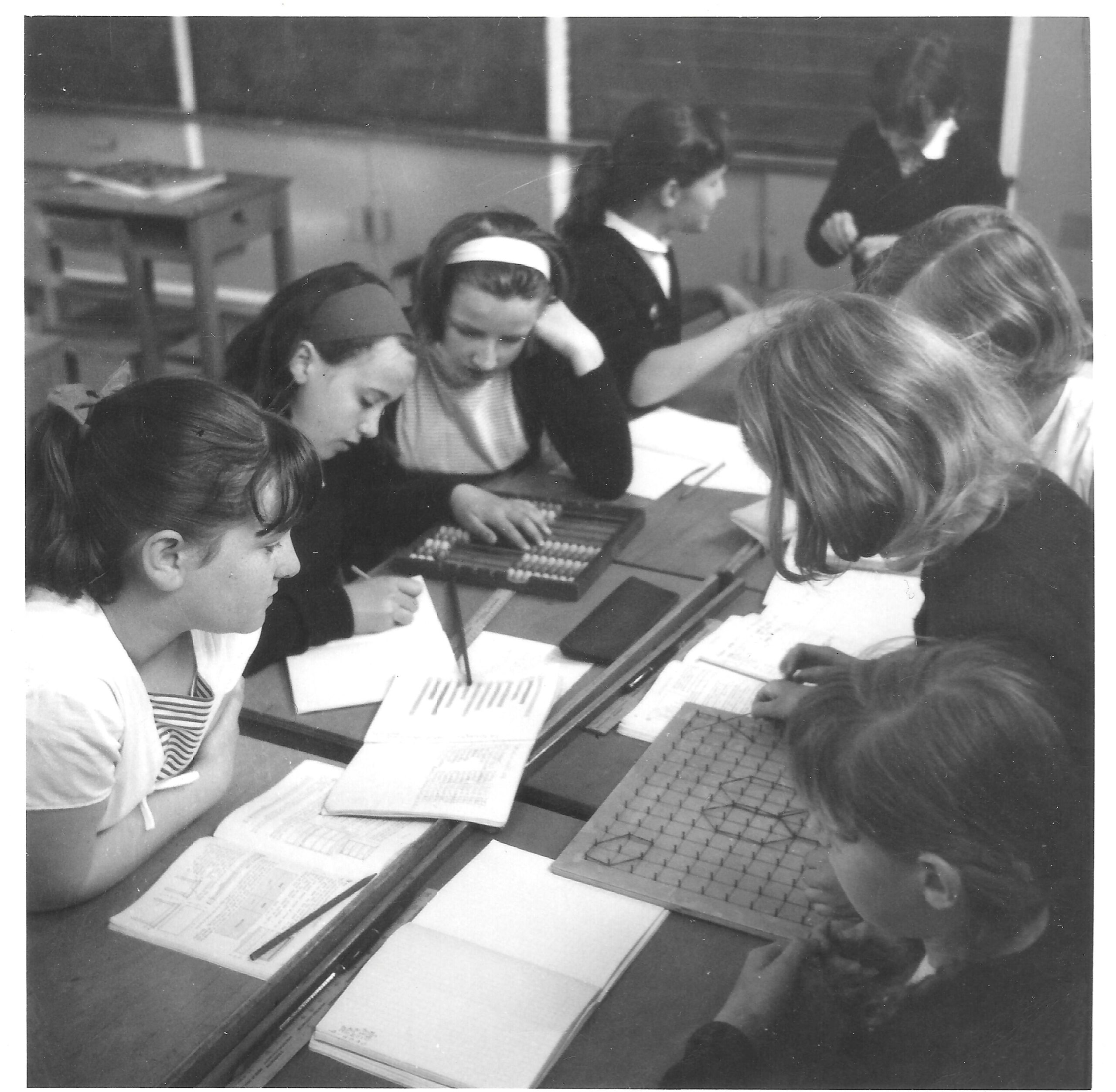
Maths lesson
f. Alan Baker, Roger Doswell  m.  Mary Samms, Nicholas Golby, Martin Skinner,
Simon Mitchell b. Suzanne Western (with back towards camera), Kevan Bundell, Martin Claytor

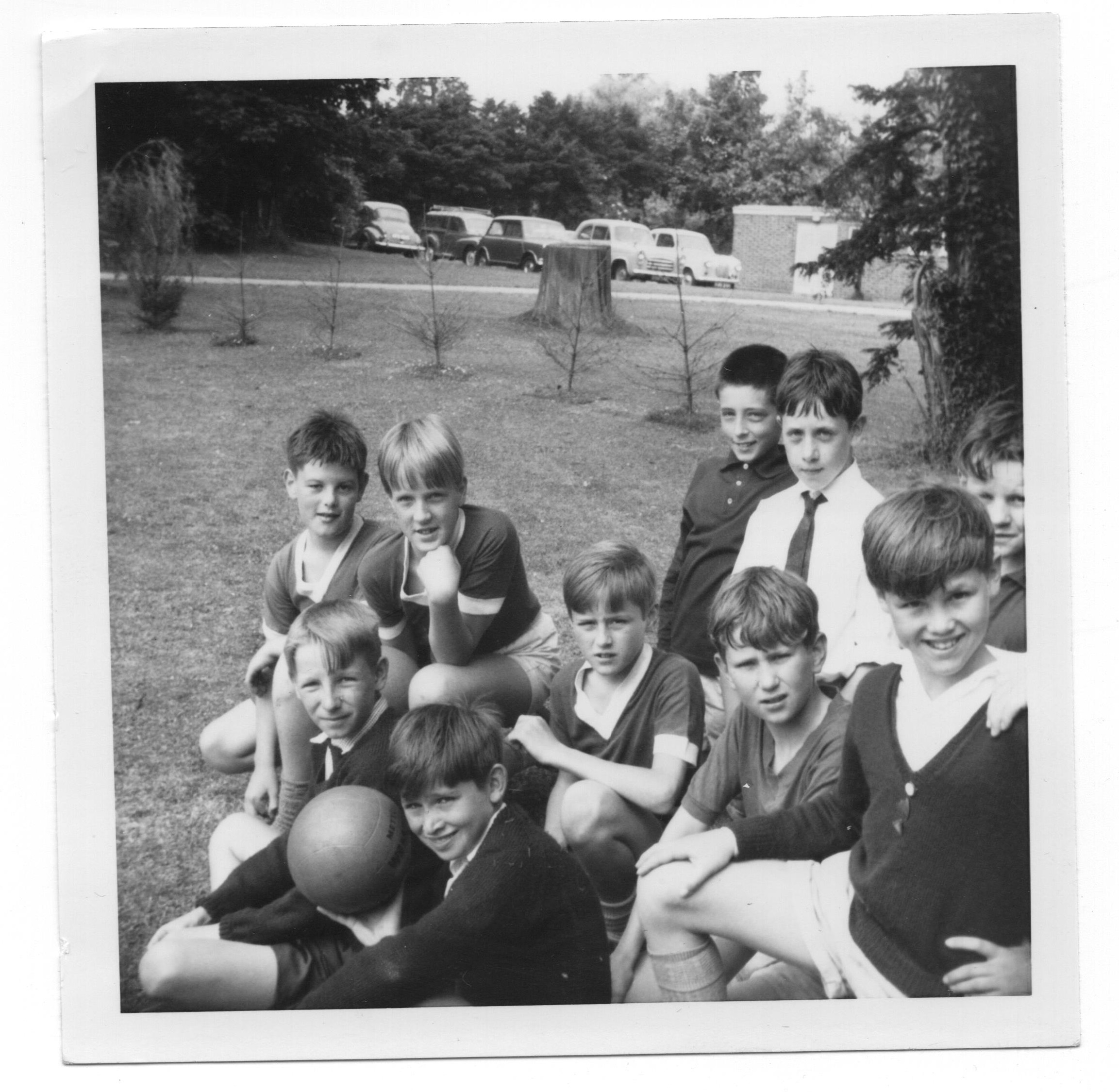
Football Team 1965 – b. -Christopher Glaum, Robert Muirhead,  ?
m. – Ian White, Martin Claytor, Gregory Able, Paul Hiscutt, Kevan Bundell
f. – Ian Cook ,  Alan Baker.


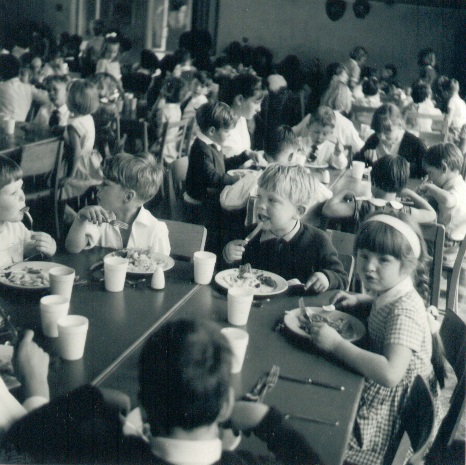
School dinner – featuring Nicky Carter (with the fork) and Avril Bundell (with the Alice Band), both aged 5.
Yvonne Tomlins and Hazel Smoulders are in charge of the table behind.


Swopping cards – with a fine display of Eastwick blazers (and badge), raincoats and caps.  And the playground wall.  Left to right : Ivor Bundell, Kyle Ingram? (short hair), Bill Sheldon, Ian Beasley, Johnnie Aldous, David Jones.


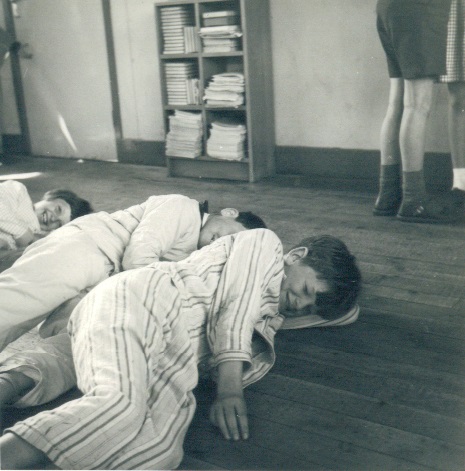
Class Play – Clare Milne,  ?  , Tony Stanton, unidentified legs . . .

Tony’s family moved to Australia in the late 60s.  The persons that bought their house told me (in ’73) that they had heard that Tony may have died in an accident.  I can believe it.  He was a dare-devil.  Nonetheless, I would happy to hear from anyone that it wasn’t true.

Here’s a photo from Diana n. Baxter :

From the left and going clockwise :  Yvonne, Joanna, Diana, Elizabeth, Jackie, Linda, Joy and Hazel.


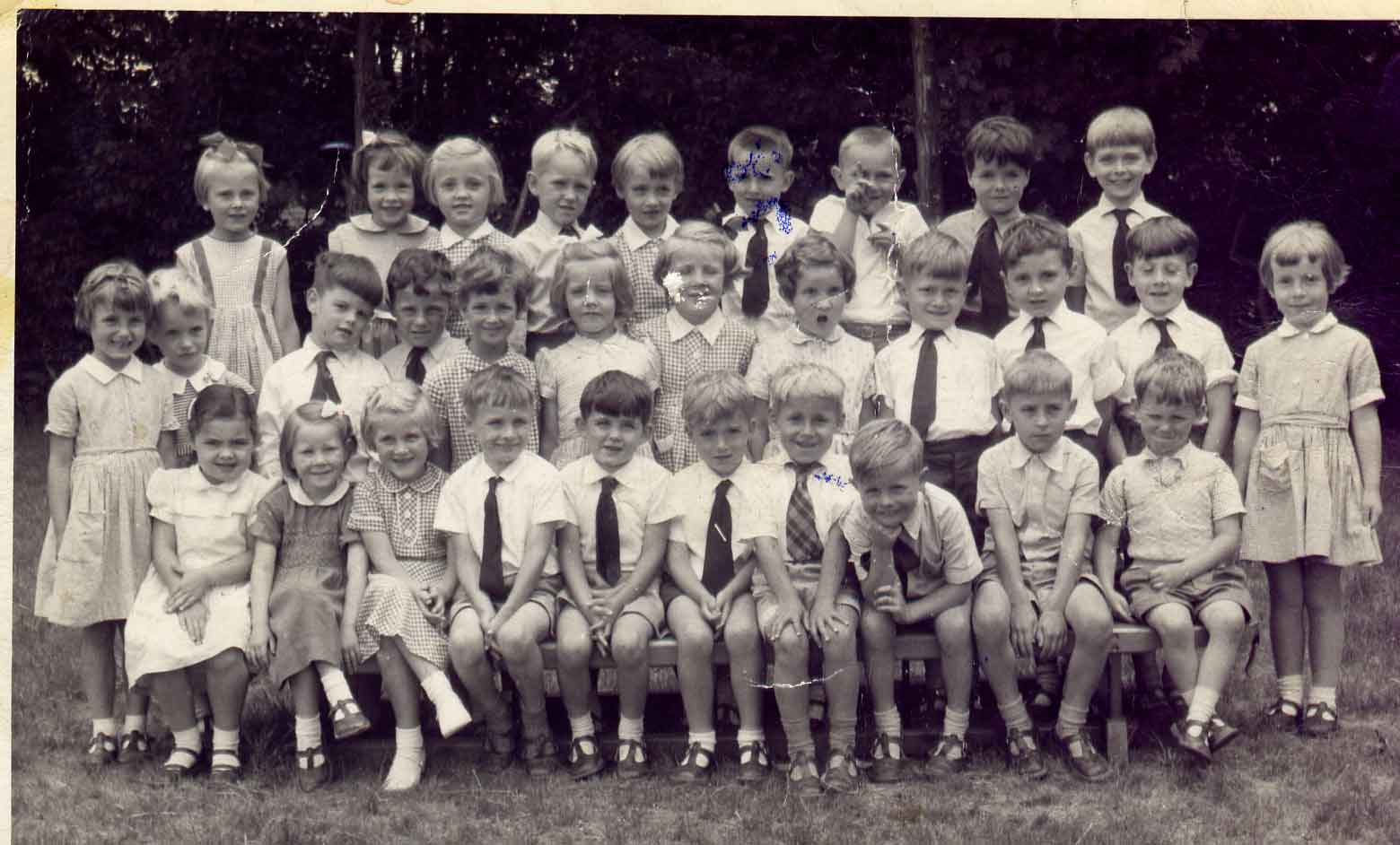
1962 ?

(Photo from Bob Medland)

b.  Avril Derbyshire, Janice Ashby, Linda Davies, Arthur Evans, Jessica Perkins, Alan Baker, Charles Richardson,  Nicholas Golby, Simon Mitchell
m.  ?   Joy Spencer, Ian White,  Phillip Barnes, Julia Heath, Hazel Smulders, Diana Baxter, Elizabeth Dalgairns, Michael Baker, Christopher Scriven, Robert Muirhead, Rona Stockwell.
f.  Linda Bannister, Marion Taylor, Amanda Webber, Roger Doswell, Robbie Medland,  ?  ,   ?  ,  ? ,  ? , Jonathan Stephens.

Note that Elizabeth has seen something shocking going on behind the photographer.  Diana has noticed it too and shut her eyes – quite properly.  Jessica, meanwhile, has seen it and is still looking !

Spot the Start-Rite sandals.

1965/66

(Photo from Martin Claytor)

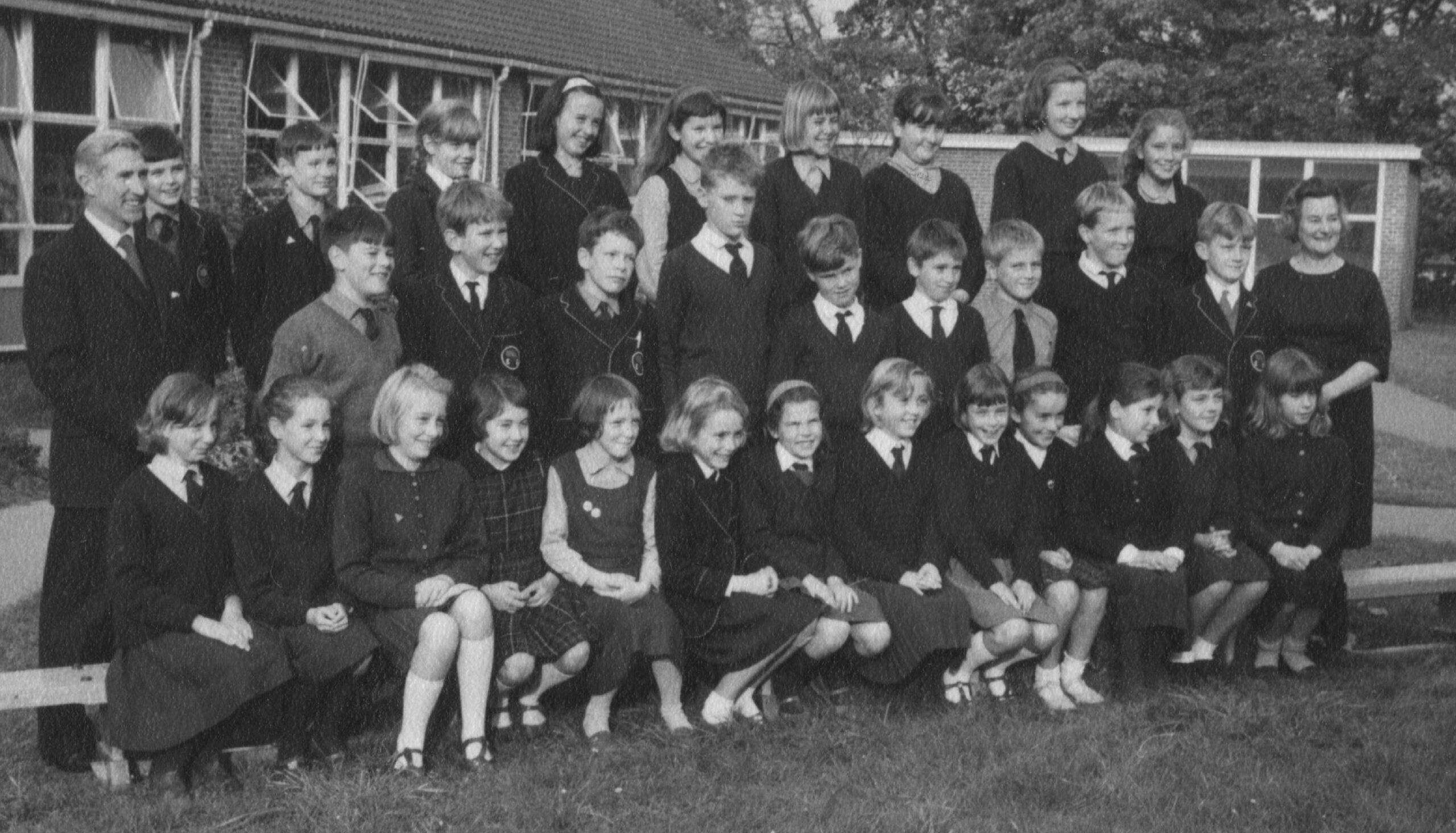
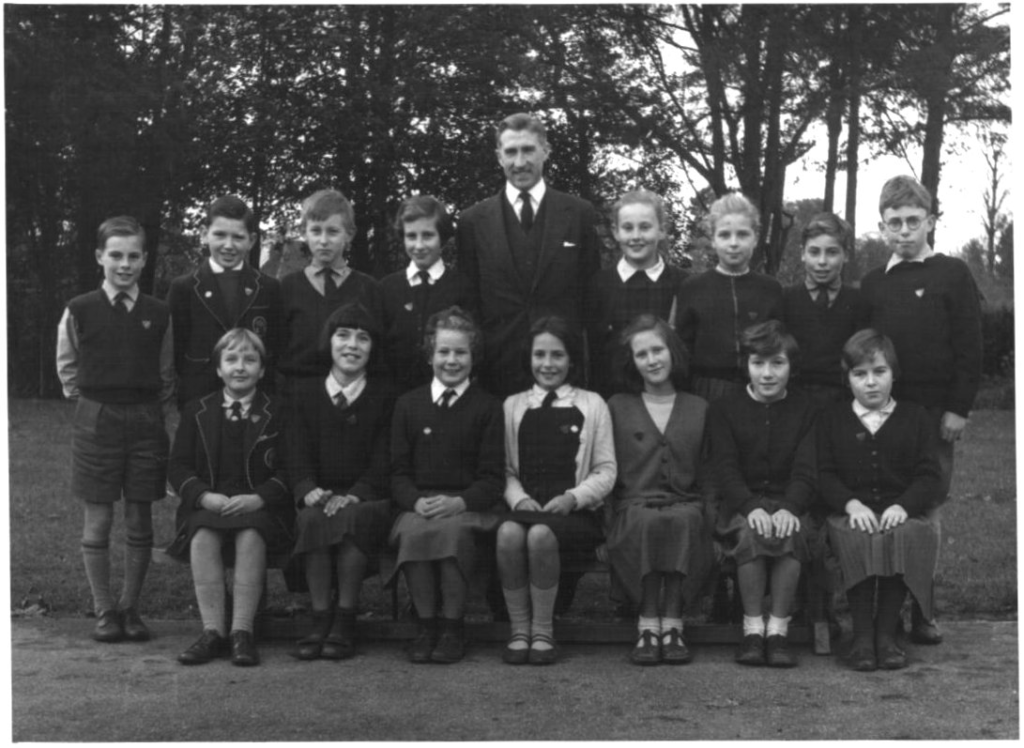
Miss Bayley’s Class 1965/6

b. – Mr Taylor, Robbie Medland, Roger Doswell, Hazel Smulders, Joanna Woods, Elizabeth Dalgairns, Avril Derbyshire, Yvonne Tomlins, Diana Baxter, Jennifer Mountain.
m. – Ian White, Paul Hiscott, Mark White, Laurence Robinson, Kevan Bundell, Alan Baker, Gregory Abel, Martin Claytor, Michael Baker, Miss Bayley
f. – Julie Dowden, Julia Heath, Jessica Perkins, Julia Gardner, Mary Samms,  Joy Spencer, Hilary Capeling, Linda Davies, Jackie Russell-Bates, Mary Sturgeon, Lynne Parkinson, Suzanne Weston, Carolyn Taylor.


Miss Lorna Bayley

Miss Bayley joined the staff of Eastwick Primary School, I calculate, sometime in 1963/4. I remember her arrival. Suddenly things began to change in our morning school assembly. There were new ideas, new components, creative changes.

She taught my older brother Arnold in his last year at Eastwick in ‘63/4. She became my class teacher in September ’64, and remained so for two years until I left in July 1966.

She had a one-eyed Song Thrush in her garden called Nelson.

She introduced a maths-teaching tool called Colour Factor which was very modern but which I totally failed to comprehend.

It was the time of the Tokyo Olympics. She set maths questions on the board and a race to answer them, awarding Gold, Silver and Bronze stars to the winners . . . I remained starless.

However, she also got us boys gardening (photo above – the girls were busy dressmaking I think) – and she put up a bird table outside the classroom window. This was pioneering stuff. At this time feeding the birds mostly meant throwing crusts of bread out in the back garden or hanging up bacon-rind. She bought proper bird feed. She put up large RSPB bird identification charts on the classroom wall and Robbie Medland and I competed to identify each bird (Robbie always won). We thereby came to know birds which we had never actually seen – and many which I have still not seen.

Miss Bayley also encouraged my artistic leanings – drawing and painting animals and birds. She even set me up with a one-boy show of my work on the corridor wall.

She paid for me to join the RSPB, and continued to pay my subscription for some years after I had left Eastwick and moved away. We corresponded during that time, until I grew into a teenager and probably just stopped writing any more.

I did meet her once during those few years, at an Eastwick School fete in 1968 or ’69. By this time I had been growing for a couple or so years. I towered above her.  As the photo above shows, she was really very short, only I hadn’t noticed when I was short too. Now I was an awkward teenager. I don’t know what I said to her. I hope I thanked her for being so very good to me.


*

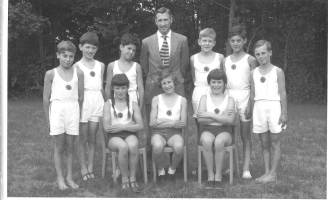
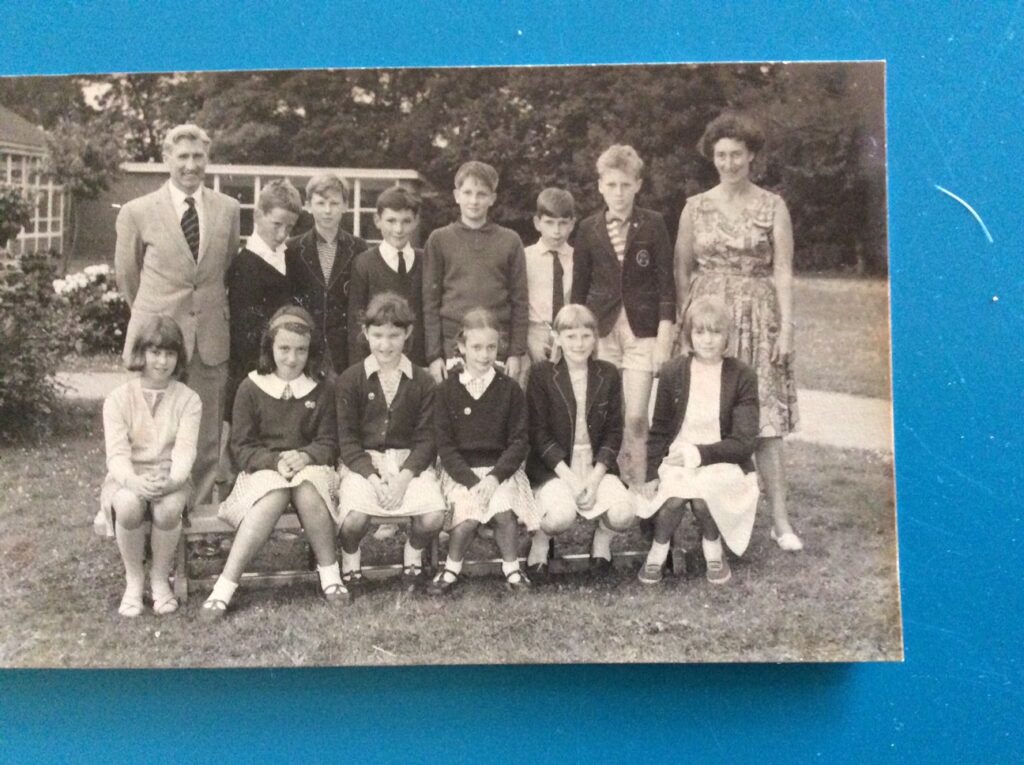
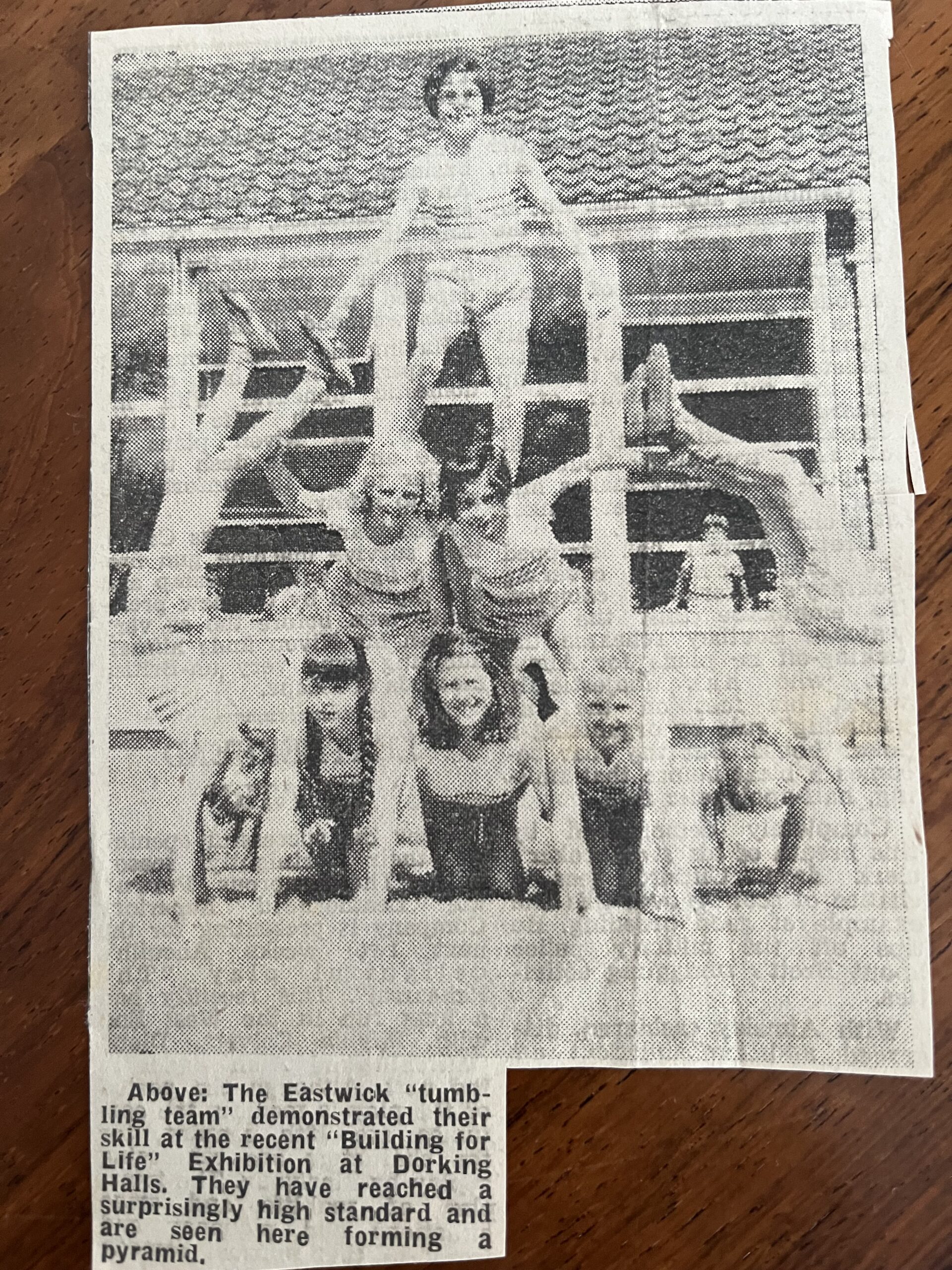
The Tumbling Team, 1960 :


Back row: David Pody, Trevor Storey, Richard Bryan, Mr Taylor, Robert Francis, Paul Guttridge, Anthony Rowley
Front row: Mary Scoble, me, Geraldine Scoble  (Names supplied by Maureen Argyle nee McConnell).


I think that must be the great sycamore in the background.

I didn’t know any of the 1960 Tumbling Team, I only remember that from the time I joined Eastwick (in 1960) I watched each year’s team perform at the school’s Summer Fete and yearned to be part of their fantastic gymnastics.  What I loved most was their quick-fire sliding across dining tables in alternate directions routine.   Mr Taylor was the coach.  The team members were selected from the top class only.  I finally reached the top class – in September 1965.  Mr Taylor asked for volunteers.  I volunteered.  We had our first  session in the school hall.

Tragically, that first session turned out also to be our last.

I was (still am !) devastated.

Perhaps Mr Taylor was by then too busy being Headmaster to find the time for training a Tumbling Team.  (I also recall that, by then, he no longer entertained us with the occasional Brer Rabbit story in morning Assembly).  Who knows ?

I could probably have been an Olympic gymnast if only there had been an Eastwick Tumbling Team in 1965/6.

 *

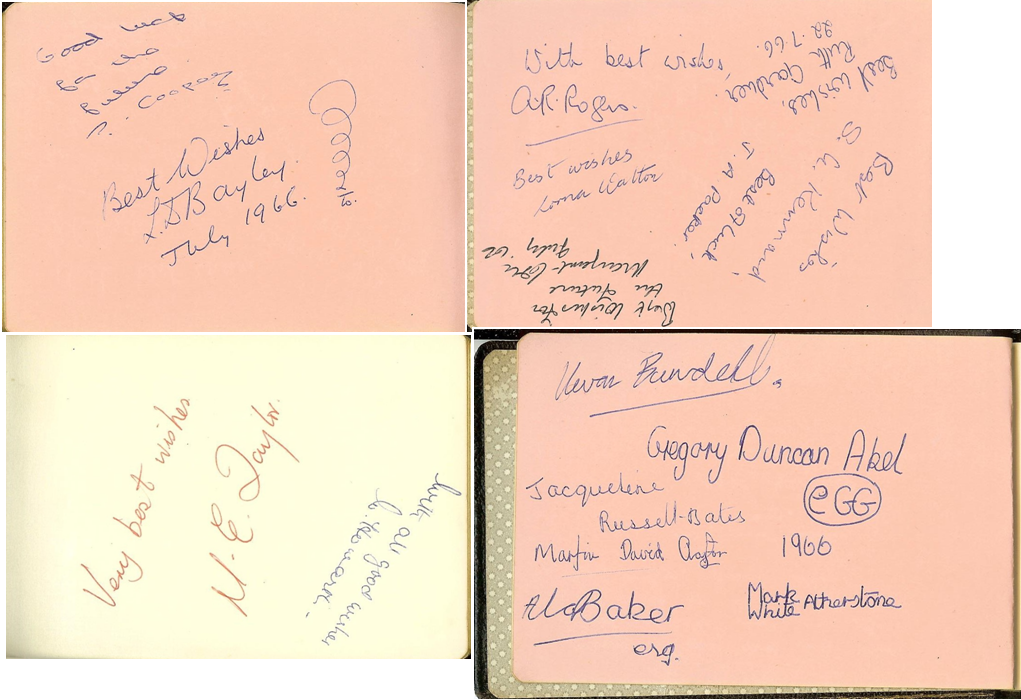
Bob Medland sent me some pages from his Autograph book of 1966.  You may have to turn upside down to read some of them :


1965

Daily Mail (June’65) :   Jackie Russel-Bates, Linda Davies, ? ,  ? , Paul Hiscutt ? , Michael Baker, Martin Claytor, Diana Baxter ? , Laurence Robinson.

*

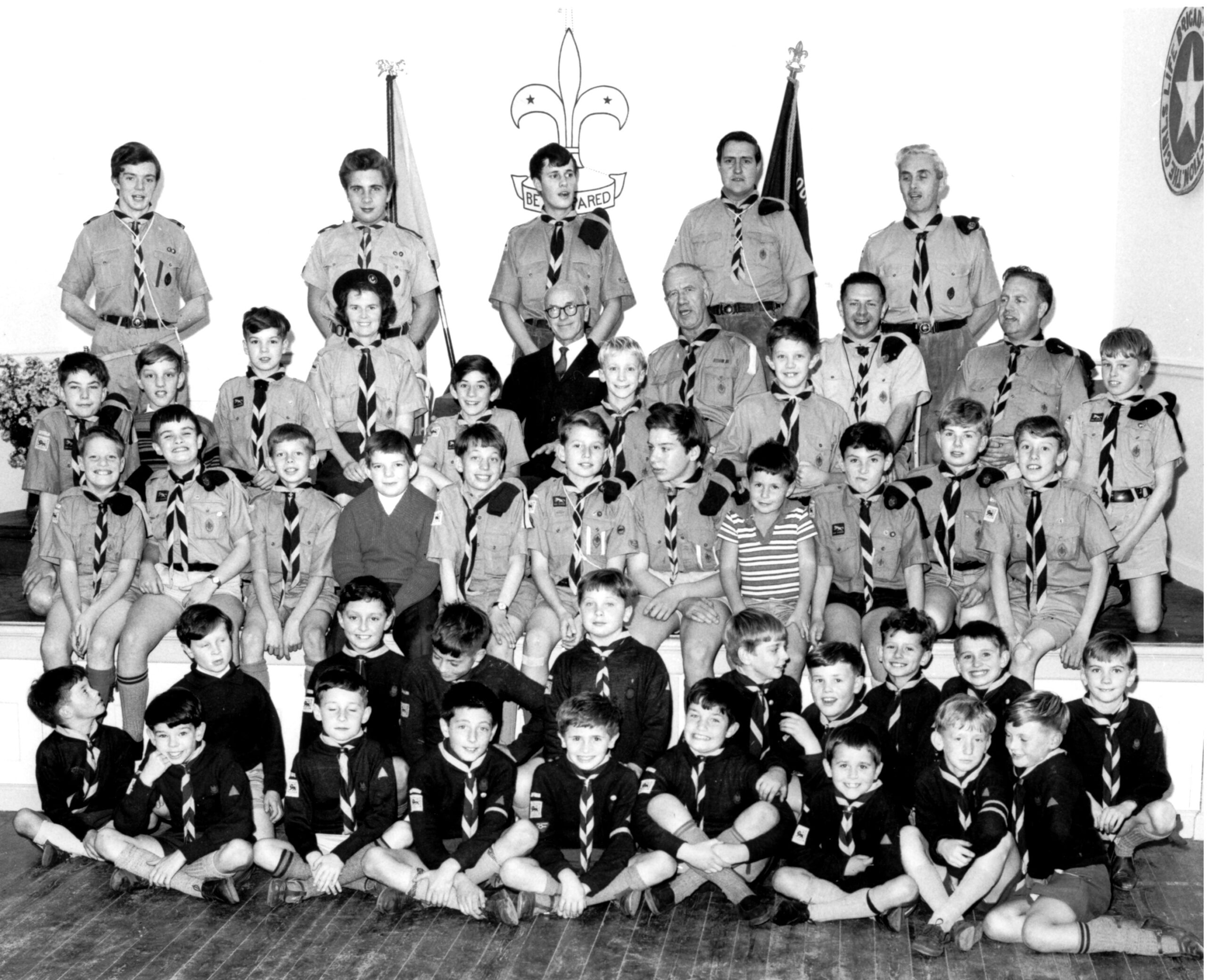
Cubs and Scouts (1964 ?)

A number of us were members of the 2nd Bookham Cubs and Scouts, together with others from Bookham Primary School :

Row 1 (top) :  ? , Harold Franklin, ? , ‘Akela’ Mr Fournier, ‘Chip’ Bob Mills.
Row 2 :  4.  ‘Bagera’ Mrs Bellet, 6. Mr Bellet ? , 8. GSM Mr Tarrington (‘Tarry’) , 9.  Mr Keeble, 10. ‘Skip’ Jim Bundell, 11.  David Stockwell ?
Row 3 :  3.  Geoffrey Weiss ?
Row 4 :  4.  Andy Franklin, 5.  Simon Mitchell, 6. Kevan Bundell, 8. Alan Baker
Row 5 : 1. Graham Smith, 3.  Christopher Glaum, 6.  Martin George, 7.  Stephen Taylor, 8. Ivor Bundell

Thanks to Graham Smith for sending me this photo.

Please name more names !

*

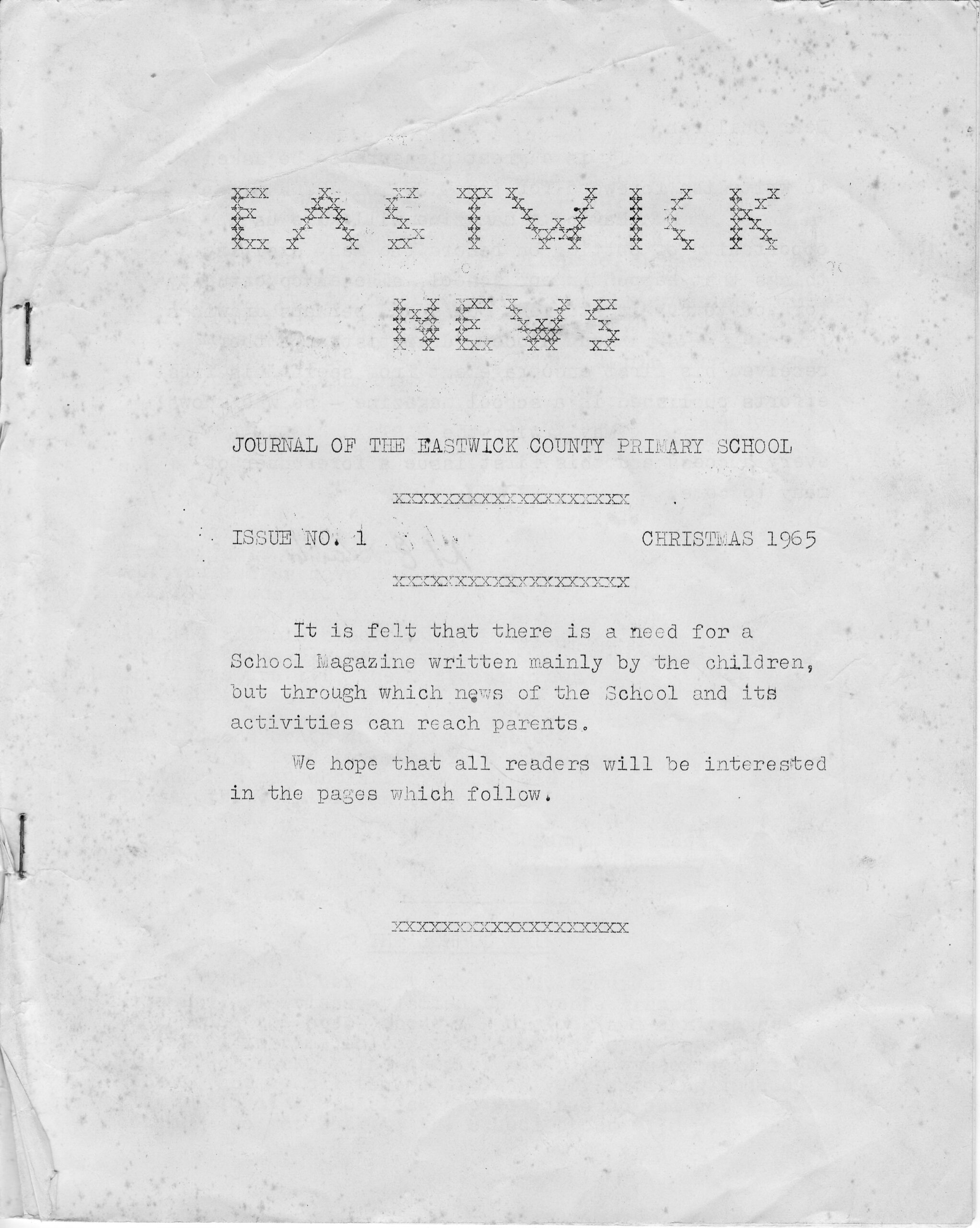
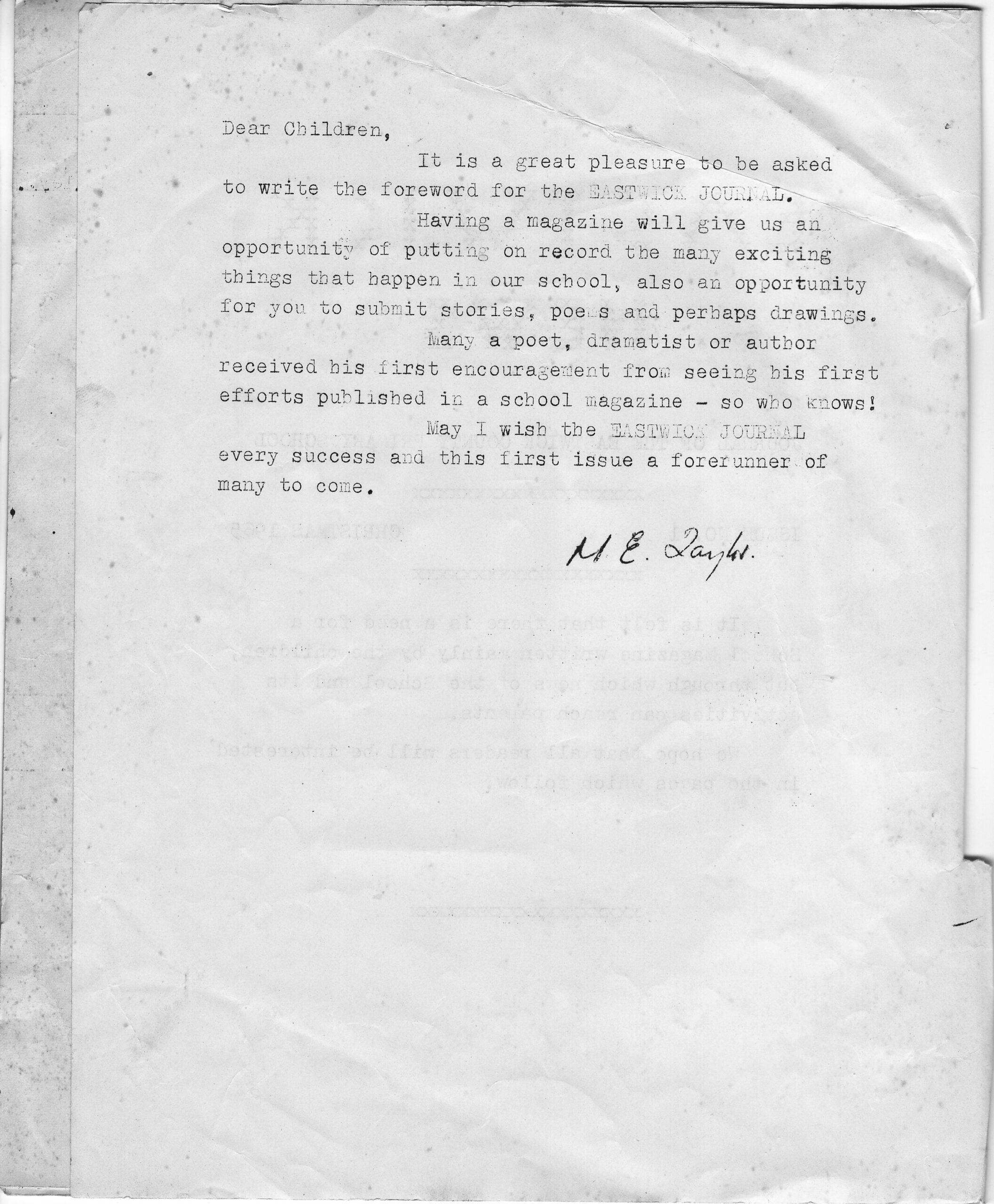
Eastwick News – 1965


Featuring contributions – poems, fiction, reports – from : Ivor Bundell, Susanne Westacott, Rona Stockwell, Alan Baker, Jean Harrowell, Louise Berry, Ian White, Simon Wright, Alan Buckland, Hazel Smulders, Anne Hart,Sheila Roddon, Jessica Perkins, Kevin Stedeford, Louise Berry, Roger Doswell and Linda Davies.

I rather think it may have been the first of only one . . .

*

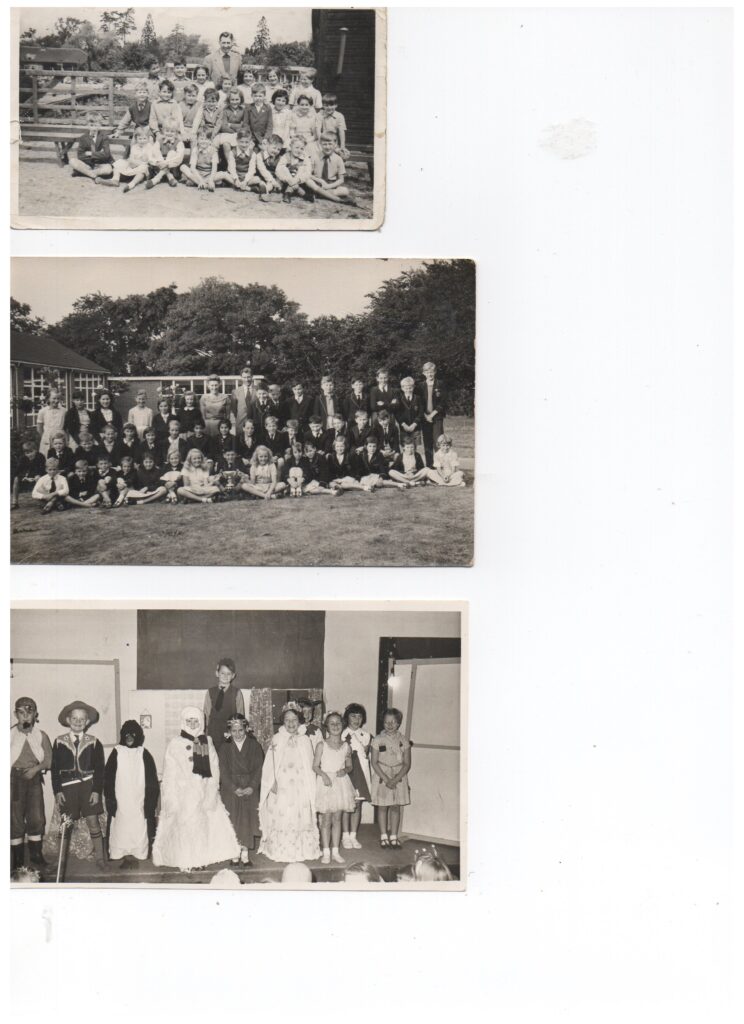
The photos below, from the late 50s/early 60s, were sent to me by Peter Bayfield, who writes :

We moved to Bookham when I was 5 years old in 1956. Initially I went to Bookham Primary School. Then when Eastwick was opened I was moved there, so probably around 1957/8. That first picture was taken in those very early days probably about 1958/9. No uniform yet. I am front row third from the left maybe aged about 7 or 8. I think that’s before the main school building was built and you can see the wooden classroom building in the background. I remember many classes with Mrs Teague in the old wooden hut that you can just see in the right of the picture.

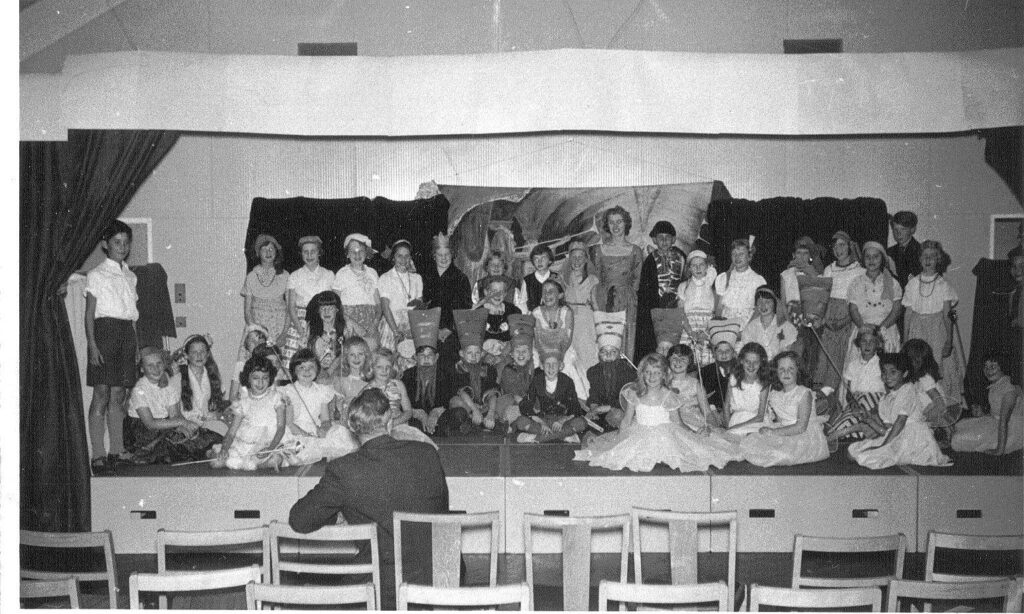
The second picture (I’m back row last on the right) would have been when I was about 11, so probably 1962. That’s the year Mrs Teague staged the Gilbert & Sullivan operetta “The Mikado” Nearly all of those in the picture had a role in the performance. I played Nanki Poo the wandering minstrel. Mrs Teague was a member of the Doyly Carte Opera Company, played piano  and had a fantastic singing voice.

The third picture must have been a fancy dress competition. I’m the cowboy.

Maureen Argyle (nee McConnell), who was at Eastwick from from Jan 59 to Jul 61, sent me these :

Back row: Anthony Rowley, Trevor Storey, ?, me, MT, Geraline Tucker, Julia Thorne, David Pody, ?
Front row: Isabel Finch, Alison Woods, Marilyn Underwood, Rosemary Hammett, Vera Bundy, Janet Hornby,  Janet Goodwin.

The Pirates of Penzance, with Mrs Teague in the middle.

Laurence Robinson – 1960-66 – sent me this :

The Swimming Team c. 1964

Mr Taylor, ? ? Graham Forbes ? ?, Gareth Moon, Laurence Robinson, Mrs Forbes, ? Joanna Woods, Elizabeth Dalgairns, Jaquie Russell-Bates, ? ?

*

I received this from Penny Jeffcoat (n. Williams) :

Hi Kevan

I came across your ‘blog’ when searching for Mrs. Teague, who was our favourite teacher.  I hope this is of interest.

Kind regards

Penny

My twin sister and I (nee Sally and Penny Williams) attended Eastick either from 1959 – 61 or possibly 1962.  Like many children there, we had to sit the Eleven Plus.  

At the time, there were in fact 7 pairs of twins and this was featured in an Evening newspaper.  Sally is trying to find the photo that our mother kept all those years ago.  The twins included Sally and myself, Beverley and Margaret Abel, and Geraldine and Mary Scoble.

My earliest memory of the area was Southey House and we used to play there before it was demolished.

We were both in the tumbling team, along with David Pody, Trevor Storey and Anthony Rowley, but we can’t remember which year.  We definitely performed at the school fete and think we are in the photo of same [above] but it is rather blurred.

OTHER PHOTOS [above] :

We are the blonde twins sitting either side of the cupholder in photo submitted by Peter Bayfield.  

We are in the photo of the Pirates of Penzance (blonde twins sitting either side of the stage) and I was one of the three little maids in the Mikado; Sally was in the chorus.  The leads were Christopher Harris as the Emperor [or was it Michael Jones ?] and Beverley Abel as Yum-Yum. We remember Mrs Teague with great affection; she was a very warm, talented and inspirational teacher.  Would love to know if she is still alive.  

*

Mike Stephens sent me this :

‘Here’s a class photo of 1959/60 or so.  I am second row back, 2nd from left with a girl appearing to sit on my knee. I have no idea who anyone is though.’

Games played at Eastwick Primary School in the 1960s

To all former Eastwick pupils :

Please read the pages under ‘Children’s Games’, and then – if anything comes to mind – please add to and/or comment on the list below via the ‘Leave a comment’ option at the end.  Thanks.

Do you remember any details of how we played these games ? Do you remember any other games/rhymes, etc. Please say if you don’t think we played a particular game or used a particular rhyme, etc :

Chasing games : Terms used for chaser – he or it (different terms are used in different parts of the country). You could also quickly say Baggsy not it !

Kiss chase
Line he – i.e. confined to the netball court lines painted on the playground
Ball he – i.e. throwing a ball to ‘catch’ the chased.
Off-ground he – i.e anywhere off the ground was ‘safe’
Chain he – each child caught then holds hand with catcher(s) to form a chain

– Was there a term and/or a gesture for stepping out of the game for a while so that you couldn’t be caught (e.g. while doing your shoe laces up) ?
– Was there a safe place where you could not be caught ?
– Could those who had been caught be released ?

Counting out – i.e. choosing who is to be it or he, etc :

Ibble obble black bobble
Ibble obble OUT !

One potater, two potater
Tree potater, four
Five potater, six potater
Seven potater, more
O U T spells OUT !

Eeny meeny miny mo . . . etc

Ip dip sky blue
Who’s it ?
Not YOU

– Counting out is often called dipping. Did we use that term ? Or some other ?

French skipping : like cats cradle, but with a long piece of elastic stretched between the ankles (then knees) of two players standing opposite each other a few feet apart. A third player has to jump over, catching the elastic with their feet, a number of times until the elastic is woven into a set pattern. Then they have to undo it by repeating their previous moves in reverse.

Hand-stands :
Get your knives and your forks and CUT IT !

Piggy-back fights : a boys game only I think.

Playing horses : two children grasp each others hands behind their backs and prance around pretending to be a pair of horses.

. . . . . . ?


Curdridge myth and legend – Kitty Nocks and the Curdridge Witch.

This is an article I wrote for the ‘Curdridge Parish News’ in 2013 :

For such a small village, Curdridge has a wealth of myth and legend.  Many of you will know the stories of Kitty Nocks and of the Curdridge Witch, although they are often confused together.  The following versions of these tales are taken from various sources, including the archives of the Botley and Curdridge Local History Society.   I am grateful to Dennis Stokes for making these available to me. 

Kitty Nocks.    

Kitty Nocks- or Nox – lived in a big house surrounded by a moat at the top of Kitnocks Hill, perhaps where the present Kitnocks House now stands.  She had a suitor of whom her father disapproved so their meetings had to be in secret.  One day she was found to be missing.  A search was made and her body was discovered drowned in the moat.  It seems she had been trying to join her lover to elope with him, although another version of the story has it that she drowned herself in a nearby pond after her lover abandoned her.

 It was after this event that the hill came to be known as Kitnocks Hill, but quite when the event took place no one knows.  However, since then her ghost is said to have haunted the top of the hill.  Her most recent reported appearance was in 1978 when a lad got off the number 53 bus at Kitnocks Hill and was scared half to death to find himself accompanied by a ghost as he ran home to Gordon Road!  

The Curdridge Witch.

As I mentioned above, there is often confusion between Kitty Nocks and the Curdridge Witch, who is sometimes known as Kate Nocks – or Nox – and it is said that Kitnocks Hill is named after her.  However, what seems most likely is that the Witch was an elderly woman called Kate Hunt who lived, sometime in the 17th century, on Mill Hill, or thereabouts, near Pinkmead and the road to Botley.  There are a number of stories told about her.

One day some trees were being cut down and fell across her garden, making her very angry.  The next day the trees were found lying in the opposite direction, across the road.  She was also said to have ridden to Bishops Waltham and back on a field gate.   A servant girl used to travel regularly by horse taking milk and eggs to Bishops Waltham.  On her way she would deliver a pat of butter to Kate Hunt.  However, when the Witch repeatedly failed to pay, the girl was instructed to stop delivering to her.  Kate Hunt became furious and declared that the girl would get to Bishops Waltham quicker than she had ever done before.  The horse then set off at a gallop and didn’t stop until it reached ‘Clark’s Shop’, where the frightened girl found all her eggs broken and mixed up with the butter.

It was also believed that the Witch could turn herself into an animal, most frequently a large white hare.  It was decided that she could not be allowed to live.  The hare was tracked down and shot with a silver bullet – the only way to kill a witch. Kate Hunt was afterwards found at her home mortally wounded and she then died. 

There is also a ghost story associated with the Witch.   A lady riding in a carriage with friends near where Kate Hunt used to live saw a woman wearing a red cloak, but no one else saw her and it was agreed that such a cloak was an unusual sight.  However, it seems that many years before it had indeed been common for elderly women to wear red cloaks.

 Confusions.

The confusions between these two characters are not just in relation to their names and to the origin of the name of Kitnocks Hill.  One story is that people used to visit the grave of the Witch Kate Knox in a churchyard nearby Kitnocks Hill to seek her advice.   They would go alone at midnight and intone her name three times and then listen for her reply.  It seems clear that this practice must in fact have related to Kitty Nocks the drowned girl and not to the Witch.

There is also confusion as to the identity of the gargoyle on St Peter’s Church tower which faces towards Kitnocks Hill and shows a woman – not obviously old – with her face displaying great distress.  Some say this is the Witch, but surely it was intended to be Kitty Nocks – unless of course those who designed the tower in the 1880s were also confused !

Kitty Noakes.

There is a third tale, not so well known, concerning Kitnocks Hill.  Commander Richard Phillimore, born and brought up at Shedfield House a couple of miles from Kitnocks Hill, told me the following brief story, learnt when he was a boy I think in the early 1900s :

There was a servant girl called Kitty Noakes.  One night, on her way home from work, she was murdered on the hill by a footpad [i.e. a mugger] and robbed of her wages.

I have not found this story written down anywhere before, but if you have heard it, or something like it, I would very much like to know.  Indeed, if you know any other versions of or additions to these stories please contact me so that I can add them to the store of Curdridge myth and legend for future generations of Curdridge folk to enjoy.

*

Sources :

Winifred G., Christy, Elsa B., It happened in Hampshire,  Hampshire Federation of Women’s Institutes, Winchester, Fifth edition 1977,  p121  (This was first published in 1936).

Botley and Curdridge Local History Society archives, The Curdridge Witch (1693/1 – 3)and The Legend of Kitnocks (1693/4 – 5).  Taken from material collected by W S J Cooke.

“The Fairy Tale Has No Landlord”: On the Enchantments of Kitnocks Hill ( https://thegrammarofmatter.wordpress.com/the-enchantments-of-kitnocks-hill/ )

Moutray Read, D.H. 1911. Hampshire Folklore. Folklore Vol.22,No.3, p314.

Stevens, F.E. 1934. Hampshire Ways. London: Heath Cranton, p.51.

Summers, M. 1946. Witchcraft and Black Magic , London and New York: Rider and Co., p.192.

Kevan Bundell

kbundell@yahoo.co.uk      


You may  also like to listen to a song I wrote called Kitnocks Hill  which recounts the tales above :  track no. 8 (around the middle) from the album Bright Day :


Kitnocks – the origin of the name.

(This article appeared in the April 2014 edition of the Curdridge ‘Parish News’).

You may have seen my article ‘ Curdridge Myth and Legend – Kitty Nocks and the Curdridge Witch’ published in the March 2013 edition of the ‘Parish News’.  That article tried to sort out the common confusion between the two characters in question. 

This article is an attempt to go beyond the legends and explore the historical origin of the name Kitnocks.  So if you prefer myths and legends to historical ‘facts’, you should stop reading now !

*

Kitnocks Hill is a significant feature of the village of Curdridge.  Local knowledge has it that the name of the place derives from Kitty Nocks,  a young girl who lived and was drowned on the hill while attempting to elope with her lover.  Exactly when she lived  is not known.  The alternative explanation is  that the name comes from the so-called Curdridge Witch, but this seems unlikely as her name was probably Kate Hunt and she seems to have lived elsewhere in the village, sometime in the Seventeenth Century.   Folklore recorders and writers appear to have confused the two characters.

Here is what we know  about the name Kitnocks from documents held in the Hampshire Records Office :

  •  In a document called ‘Customs of the Hundred of South (i.e. Bishops) Waltham’, dated 1259/60 there is mention of a Thomas Kutenok.  The implication is that Thomas was a tenant in the Hundred (an administrative area of land) [1]
  •  In the Rentals of Bishops Waltham for 1332, a Richard de Cutenok is listed as the tenant of a ‘1/2 virgate’ [a varying measure of land, typically 30 acres]. [2]
  • In the Rentals of Bishops Waltham for 1464, under the heading ‘COURDRYGGE’,  we read  : ‘a messuage [house] and 1/2 a virgate of bond land called Kotenokes, formerly Richard de Cuttenoke’.  ‘Formerly‘ here means  that Richard was a previous tenant.  This is the first reference to the land itself being known by a name.  Elsewhere in this document  we find references to ‘the land of Kutenokes’ and ‘formerly Kuttenokes’.

The spelling is all over the place, but it is clearly the same name that is being referred to.   In fact the letters  ‘c’ and  ‘k’ are interchangeable in Anglo Saxon, and the vowels could vary too.

It seems clear that the name of the place that we have today has come down to us all the way from the name of the tenant family that held the land since at least  the Thirteenth Century. 

As for the name itself, a little research reveals that ‘Cutte’ means ‘son of Cuthbert’ in Anglo Saxon,  and  that ‘Knock’ or ‘Nock’   is a shortened version of the phrase ‘atten oak’  or ‘at the oak’  (just as the name Noakes is ‘at the oaks’ or  Nash is ‘at the ashes’).   On the other hand it could be ‘atten nock’ , at a hill or knoll.

Be all that as it may,  if you have read this far and still prefer the legend of Kitty Nocks or the Curdridge Witch, you must not of course be swayed by my research.  Especially if you are in need of advice.  According to one Folklorist’s account it was customary to visit ‘Kit Knox Hill’ at midnight and to circle Kit Knox’s  grave three times,  ‘Then listen for the answer . . . council and guidance will always be given.’   I assume this custom has now died out, but do let me know if you know differently. I will then be sure to let whoever moves into the new houses just built on the top of the hill know – and tell them not to worry.

Kevan Bundell

[1] Hampshire Records Office COPY/761/1

[2] 1332 & 1464  Rentals of Bishops Waltham Manors, Harold G Barstow, 1992.

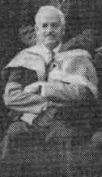
Alan Glynne-Howell (1910 ? – 1989) – an appreciation.


I first encountered the formidable Mr Glynne-Howell at the too tender age of eleven as he attempted to teach us Latin.  In my case at least, he failed utterly.  In my first year final exam I was awarded a mark of three percent – one for writing ‘amo, amas, amat’, the other two for spelling my name correctly.

  He was a generous man.

 Mr Glynne-Howell was otherwise known to us as ‘Genghis’.  On the one hand this displayed our profound schoolboy ignorance, on the other it was unarguably appropriate.  He would bear down upon us, dark of gown and of physiognomy, take us by the cheek between finger and thumb, and shake us like rabbits; he would steady our face with one hand and slap us with the other, admonishing us to ‘Take it like a man’.  He would then extract his handkerchief from his pocket and fastidiously wipe his hands of our contamination.  This was not at all what we were used to, but we were far too young, and intimidated, to protest.

 And yet there was also humour.  ‘Don’t bray like an ass’ he would say as a victim struggled to translate some incomprehensible passage.  Or more particularly, to myself :   ‘Bundell, you are like an ape staring into space – you see everything, and comprehend – nothing.’

 He was right of course.

 Later on he also taught us ‘A’ Level Religious Studies, by which time we were  a good bit older, and he less intimidating.  Nonetheless, it was only many years later – after I had left school, after I had lived in India for a while, and after I was married to an Indian – that I came to some kind of an understanding of where Alan was coming from.

 He was coming from a world which no longer existed.  India gained its independence from the British Empire in 1947.  The Raj was finished.  Like many others of Anglo-Indian descent Alan, and his wife Tessa, were face with a decision as to where to build their future.  He had done well in an India ruled by the English language and its culture.  He had obtained both Bachelor’s and Master’s Degrees in English, from the Universities of Bombay and Benares respectively, and won a William Shakespeare Cup along the way.  He had trained as a teacher and then taught at the prestigious Church schools of Bishops High in Pune and the Cathedral School in Bombay.  He had taught the sons of Rajas, as well as the sons of other important members of the Hindu, Christian and Muslim communities.  But the world in which he had been brought up, and in which he had competed, was quickly fading – and England had always been referred to as home.

 In 1962 the Glynne-Howells decided, like other members of their family, to move to the UK.   Alan first taught at an independent girl’s school in St Ives, Cambridgeshire.  One wonders what the girls made of him – and he of them.  Presumably he did not require them to ‘Take it like a man’.   In 1965 he joined Price’s Grammar School for Boys in Fareham, Hampshire.  It was a rather traditional establishment, with something of the English public school about it, and was led by a Headmaster, Mr E.A.B. Poyner, of firm Christian convictions.  These characteristics would no doubt have helped Alan feel at home.

 However, this was the nineteen sixties and England, like India, had also changed, and was changing still.  At Price’s Alan was largely put to teaching Latin, obligatory in the first year, but never a greatly popular choice thereafter, and Religious Studies – of which he was Head – but again a minority pursuit beyond the statutory one class a week.   Meanwhile he was denied the opportunity of teaching his beloved English Literature.  I believe this may have been at least partly owing to a perception that Alan’s approach to the subject was rather old fashioned.  And so it no doubt was.  Yet Alan’s old fashioned erudition and use of the English language were glorious, and I for one have never recovered from them.

At the same time, outside of school, Alan suffered on occasions the prejudice and name-calling that those ‘of a dusky hue’, as Alan put it, had to endure in a provincial town at a time when non-white faces were not at all common.  This must have been particularly unpleasant for a man of Alan’s background and sensibilities.

 Another thing I understood from living in India was that Alan’s assaults upon our eleven year old cheeks were not in fact acts of aggression but rather of affection.  In India grown-ups commonly pinch the cheeks of children or give them a gentle slap while admonishing them for some minor misdemeanour, or indeed for none at all.  And the children grin back at them.

 And yet, as I recall, Alan was always rather serious about it.  He was fearsome of aspect (as he would have put it), and, often, it hurt.

 In fact, he was conflicted.  We were his pupils and therefore dear to him.  But we were also an ignorant and rather ordinary bunch of boys, from very middle or working class backgrounds.

  And above all, we were unwashed.

 Alan’s fastidious wiping of his hands after every contact was not merely a performance.  It was also a comment upon and a criticism of our personal washing habits.  No doubt small boys everywhere are among the least fragrant members of society.  However, Alan was also possessed of a particularly sensitive nose.  In India his pupils would have routinely bathed every morning.  In England in the 1960’s, before the general arrival of domestic showers, a bath once a week was more the norm.  Of course we were also obliged to take showers at school after PE and Games, but it was amazing how quickly boys could rush in and out of the shower room, and then climb back into clothes which had probably already been worn for the best part of a week.

 At some point in 1967 or ’68 Alan fell ill and was away from work for a term or more.  When he returned we were all shocked to see that his formerly coal black hair had turned quite white.  Unfortunately his health was never of the best in his later years, especially after he retired in 1975.

 Shortly before he retired Price’s became a sixth form college and there were not only boys about but also girls.  This gave rise to new opportunities for Alan to express himself in his characteristic and inimitable style.  Tony Johnson, then Head of English, tells the following tale :

 “A phrase that passed into the folk memory of staff at Price’s
College was his. Rounding a corner on his way to the staff room, he
reported to us that he had just seen two students in “amorous
juxtaposition”. Even to this day you have only to mention that
phrase to bring laughter to old colleagues who have met for lunch.”

It was my brother Ivor – also a pupil of Alan’s – who first began to visit Alan at home, and then I joined him.  This was when we first met Tessa.  By this time Alan had clearly forgotten, or chose to ignore, my achievements in his Latin class.   His conversation was always riddled with sage – I assume – remarks, quotes, and aphorisms in Latin.  Sometimes he would translate, but often-times he would not.  Fortunately there was more than enough of the same in English to give me some chance of joining in the conversation.

 Later on my wife and I visited, usually for afternoon tea, sometimes with our children.  Alan and Tessa would also come to tea with us.  I remember an occasion we visited when both Alan and Tessa were, by then, less nimble than they had once been.  My wife, in very Indian fashion, soon took over the serving of the food and tea and Alan and Tessa were obliged to be waited upon, as befitted their age and status.  Alan was flustered and embarrassed at being looked after in such a way in his own house, but at the same time I felt he was also moved by the touch of his old home and culture.

 Alan passed away at the very end of December 1989.  His memorial service was conducted by another of his former Price’s pupils, Peter Hancock.   We continued to have Tessa round for tea until she passed away in 2013.  In any case Alan is still often mentioned and in our minds.   It was a very special experience –  in a variety of ways –  to have had Alan as a teacher.  Although I understood, if not quite nothing, only a limited amount of what he might have taught me, it was a gift to have known him.

 Kevan Bundell
(Price’s 1966 – 73)

Revised Version (so to speak) Feb. 2014

The original posting of this Appreciation can be found on the web site of the Society of Old Priceans at : http://www.societyofoldpriceans.co.uk/Alan_Glynne-Howell.htm