Month: September 2019
Frog Mill or Paper Mill ?
Frog Mill or Paper Mill ?
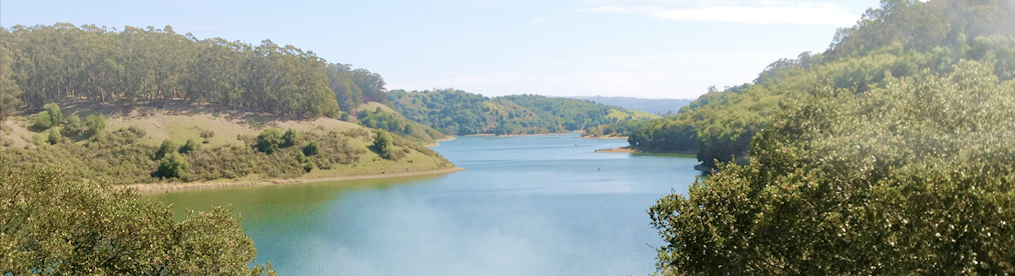
A few months ago I mentioned in the Parish News that Frogmill Track – off Wangfield Lane – is so-called because it leads, by footpath, to the now derelict Frog Mill. This was a paper mill, not a corn mill. Rumour says that it used to make paper for Bank of England bank notes, or for the Morning Post newspaper. After my comment appeared I received a phone call from Miss Katherine Stone, formerly of `The Elms’, Outlands Lane, now living in Botley. She was keen to tell me that the correct name of the mill is Paper Mill, not Frog Mill. Her grandfather lived there and always called it by that name.
Here was a mystery. It is certainly known as Frog Mill, or Frogmill, nowadays, and is named as such on OS maps. But even within living memory it was also, it seems, known as Paper Mill. I immediately contacted Dennis Stokes of the Botley and Curdridge Local history Society to see if he could help solve the conundrum. He sent me a paper from the Society’s archives, researched and written by John Hammond , which tells the following story :
Just a quarter of a mile upstream from Frog/Paper Mill sits Durley Mill. In the 12th, 13th and 14th centuries this mill was owned by a family called Frogge. Furthermore the deeds of this mill called it `Frogmill’ right up to the 20th century. Our mill, meanwhile, was, from its earliest record, in 1648, `called a Papermill’ and it was not until 1738 that it is first referred to as Frog Mill. By 1834 it is clearly referred to as `a paper mill known as Frogmill’.
There was obviously some confusion over the centuries and the name Frog transferred from Durley Mill to the Paper Mill, despite the name Frogge remaining on the former’s deeds. John Hammond suggests that Durley Mill `was, no doubt, referred to generally by the name of whoever the owner at that time might be’. This would explain at least why it lost the Frog name over time, leaving the name free to float downstream.
By 1862 Paper Mill was, according to its deeds, `long since disused’, although people continued to live in its associated cottage. John Hammond reports that Jesse Bannell (who was Ms Stone’s Grandfather) and his family lived there from 1871 until at least 1891 and that Walter Henry Elliott and family lived there from 1901 until the 1920s. By 1938 the cottage was no longer occupied and by 1965 the building were all derelict.
It remains a minor mystery how it was that while everyone else followed the confusing of the names and mills, those who lived there still knew very well that the `correct’ name was in fact Paper Mill. We must thank Miss Stone for keeping this knowledge alive.
Kevan Bundell
11.08.15
Rock Shelter Paintings – Sirumalai
This article reports two rock shelter sites with possibly prehistoric paintings located in Sirumalai, Dindigul District, Tamilnadu, S. India. The first site was reported in the Indian Express newspaper in 1984[1]. The second site has not to my knowledge been previously reported.
Sirumalai is an isolated group of hills lying to the North of Madurai and to the South-east of Dindigul. It is partly forested and partly cultivated. Some slopes, particularly on the western edges, are not easily accessible. The hills are occupied mostly by mainstream Hindu people originally from the surrounding plains. However, they are also home to Paliyar adivasis (tribals), many of whom continue to lead a traditional nomadic or semi-nomadic way of life.
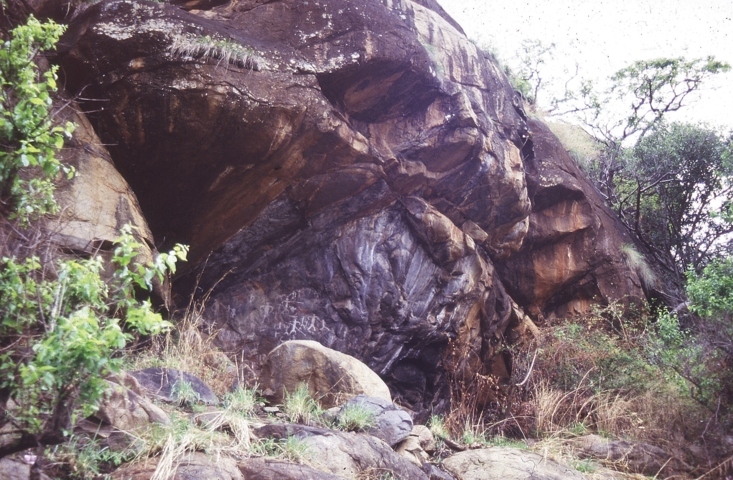
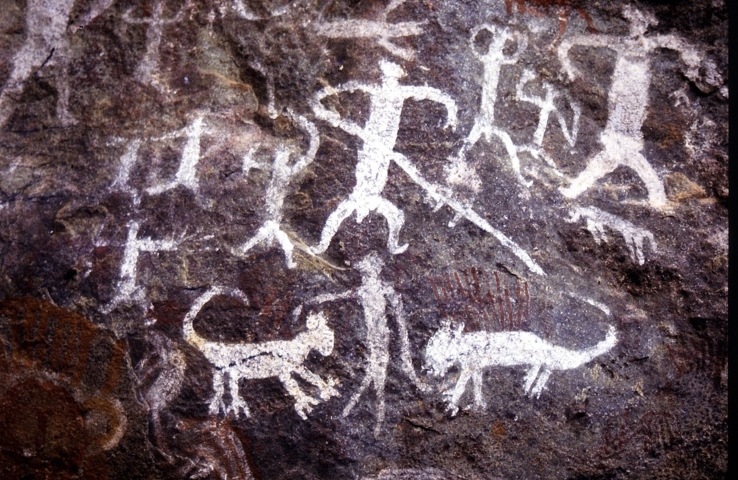
The first rock shelter is at Aruvimalai on the south-western corner of the hills, somewhat above Maavuttaru Lake[2] and just below a small dam. The rock shelter was visited by Dr G Vijayvenugopal, Reader in Tamil, Madurai Kamaraj University, sometime in 1983/4. He was brought to the site by Sirumalai locals, including a Paliyan[3]. I met Dr Vijayvenugopal in July (?) 1984. He suggested the paintings might date from about 500 BC. I then visited Aruvimalai myself with the help of some locals. I took photos of all the paintings. (See the Sirumalai Gallery Tab). They are painted in red ochre and white and consist of human, animal and other figures. The site is clearly a rock shelter, not a cave, with the cliff overhanging the level area beneath. The shelter was visited subsequently by M. Christian Journet on 19.09.2015, accompanied by Sri ? Suscindran of Sirumalai Palaiyur. M. Journet understood the location to be called Meenmittuparai, at 10°09’18.0″N 77°58’36.0″E, that is, on the eastern tributary that feeds into Maavuttaru Lake. M. Journet also took photos which he has kindly allowed my to post on this site. (See the Sirumalai Gallery Tab).
The second rock shelter is, I believe, at or near Alangaltheri, in a cliff face at the head of a forested valley above the settlement of Thalikidangu. I visited the site in July 1984. Again, it is in the south-western part of the hills, although I am otherwise not sure of its precise location. I was taken there, by a Paliyan, after a walk through the forest on no visible pathways. We then had to climb down a short way to reach the site.
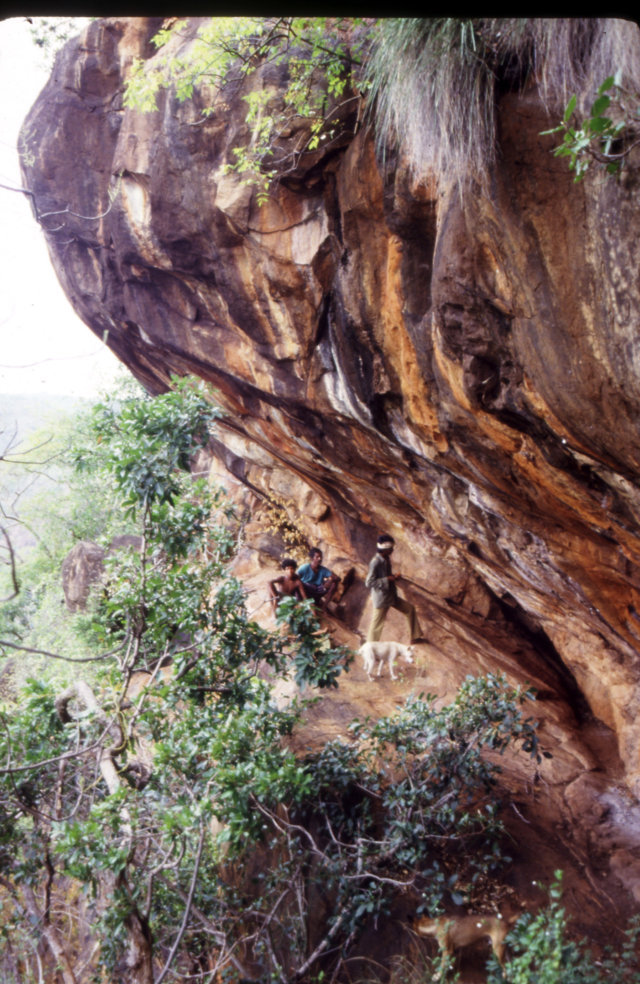
The shelter was some 30 feet long, varied between 16 and 6 feet in height and 20 to 4 feet in depth. It sloped some 30 to 40 degrees above the level ground. The remains of a fire suggested that the shelter had been recently used. The presence of modern Tamil letters among the apparently prehistoric paintings also suggested that this shelter had been in more contemporary use.
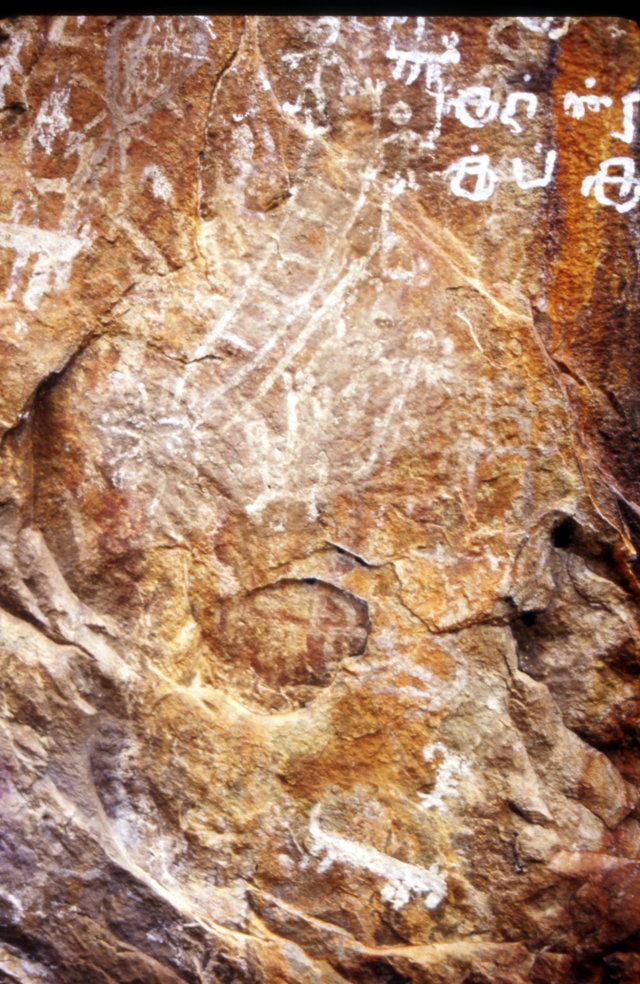
Again, I photographed all the paintings. (See the Sirumalai Gallery Tab). I also asked the locals who had accompanied me – Hindu Tamils and the Paliyan guide- to interpret some paintings whose ‘meaning’ was not clear to me. I have added notes to some of the photographs accordingly.
Higher quality versions of the photos are available on request.
I would welcome informed feedback on this post.
Kevan Bundell
Birds of Sirumalai, Tamil Nadu: 1980–2009. Indian Birds 5 (5): 143–145.
Introduction
This paper reports the birds observed in Sirumalai (Little Hills) in
the Dindigul district of Tamilnadu by the author in the years 1980,
and 2009. It includes observations reported by Swami (2006), and
additional reports by local informants to the author in 2009. It also
makes reference to a list of the birds of the Palani Hills published
by the Palani Hills Birdwatchers Society1.
The author was privileged to stay in the village of Sirumalai
Palaiyur for a period of eight months, from January to August, in
1980, and to return for a period of five days in January 2009.
In geological terms it would seem that Sirumalai is one of the
southernmost outposts of the Eastern Ghats.2 However, in terms of
its location, it is close to the Western Ghats, and more particularly
to the spur of the Palani Hills, from which it is separated at the
narrowest point by a distance of only 12 km or so. Although
Sirumalai has been studied in some detail in terms of its flora
(Pallithanam, 2001; Karuppusamy et al. 1999; Kottaimuthu et al.
2008), there seems to be little of substance published on its fauna
in general or, other than Swami (2006), on its birds in particular.
Sirumalai lies to the north of Madurai, and to the south of
Dindigul. The surrounding plain lies at an average height of about
300 m. Sirumalai, roughly speaking, consists of an outer ring of
hills at an average height of about 1,000 m, though with a number
of peaks exceeding 1,350 m, and a central bowl at about 700 m. The
hills rise more or less abruptly from the plain in the north, west,
and south while tapering away into low hills to the east. Much
of the hills are reserved forest, including areas of more or less
natural dry evergreen and semi-evergreen forest; some is coffee,
and other plantation, often with mature, planted tree cover; and
the remainder is cultivated by local smallholder agriculturalists or
larger landowners. Three main streams run through the hills, and
down to the plains. Sirumalai receives its only significant rainfall
between October and December with the NE Monsoon . . . .
(For more please follow this link to Indian Birds : http://www.indianbirds.in/pdfs/IB_5.5_143-145.pdf
Birds of Sirumalai – Further observations, February 2015.
This note is an up-date to the observations reported in Indian Birds 5 (5): 143–145.
I visited Sirumalai again in February 2015. The list below records all species observed during my visit, with those not previously reported given in bold.
• Ashy Woodswallow Artamus fuscus
• Asian Paradise flycatcher Terpsiphone paradisi
• Black-headed Cuckoo-Shrike Coracina melanoptera
• Black-hooded Oriole Oriolus xanthornus
• Black-naped Monarch Flycatcher Hypothymis azurea
• Blue-throated Flycatcher Cyornis rubeculoides
• Brainfever Bird Hierococcyx varius
• Brown Shrike Lanius cristatus
• Brown-headed Barbet Megalaima zeylanica
• Common Iora Aegithina tiphia
• Common Myna Acridotheres tristis
• Egyptian vulture Neophron percnopterus
• Greater Coucal Centropus sinensis
• Grey Junglefowl Gallus sonneratii
• House Swift Apus affinis
• Jungle Babbler Turdoides striatus
• Jungle Crow Corvus macrorhynchos
• Little Egret Egretta garzetta
• Rufous-backed Shrike Lanius schach
• Blue-winged Parakeet Psittacula columboides
• Nilgiri Laughingthrush Garrulax cachinnans
• Oriental Magpie-Robin Copsychus saularis
• Indian Pond-Heron Ardeola grayii
• Pied Bushchat Saxicola caprata
• Plum-headed Parakeet Psittacula cyanocephala
• Red-rumped Swallow Hirundo daurica
• Red-vented Bulbul Pycnonotus cafer
• Red-whiskered Bulbul Pycnonotus jocosus
• Scarlet Minivet Pericrocotus flammeus
• Shikra Accipiter badius
• Little Scaly-bellied Green Woodpecker Picus xanthopygaeus
• Tawny Eagle Aquila rapax
• Indian Treepie Dendrocitta vagabunda
• Velvet-fronted Nuthatch Sitta frontalis
• Indian Hanging-Parrot Loriculus vernalis
• White-breasted Kingfisher Halcyon smyrnensis
• White-cheeked Barbet Megalaima viridis
Also :
Grizzled giant squirrel Ratufa macroura
Hanuman langur Semnopithecus entellus
Bonnet macaque Macaca radiata
Gaur Bos gaur
For a further study of the birds of Sirumalai please see : http://indianbirds.in/pdfs/IB.9.3.SantharamETAL.Sirumalai.pdf