From ‘Under the Old School Topee’, Hazel Innes Craig, British Association for Cemeteries in South Asia (BACSA), Putney (1990, 91, 96).
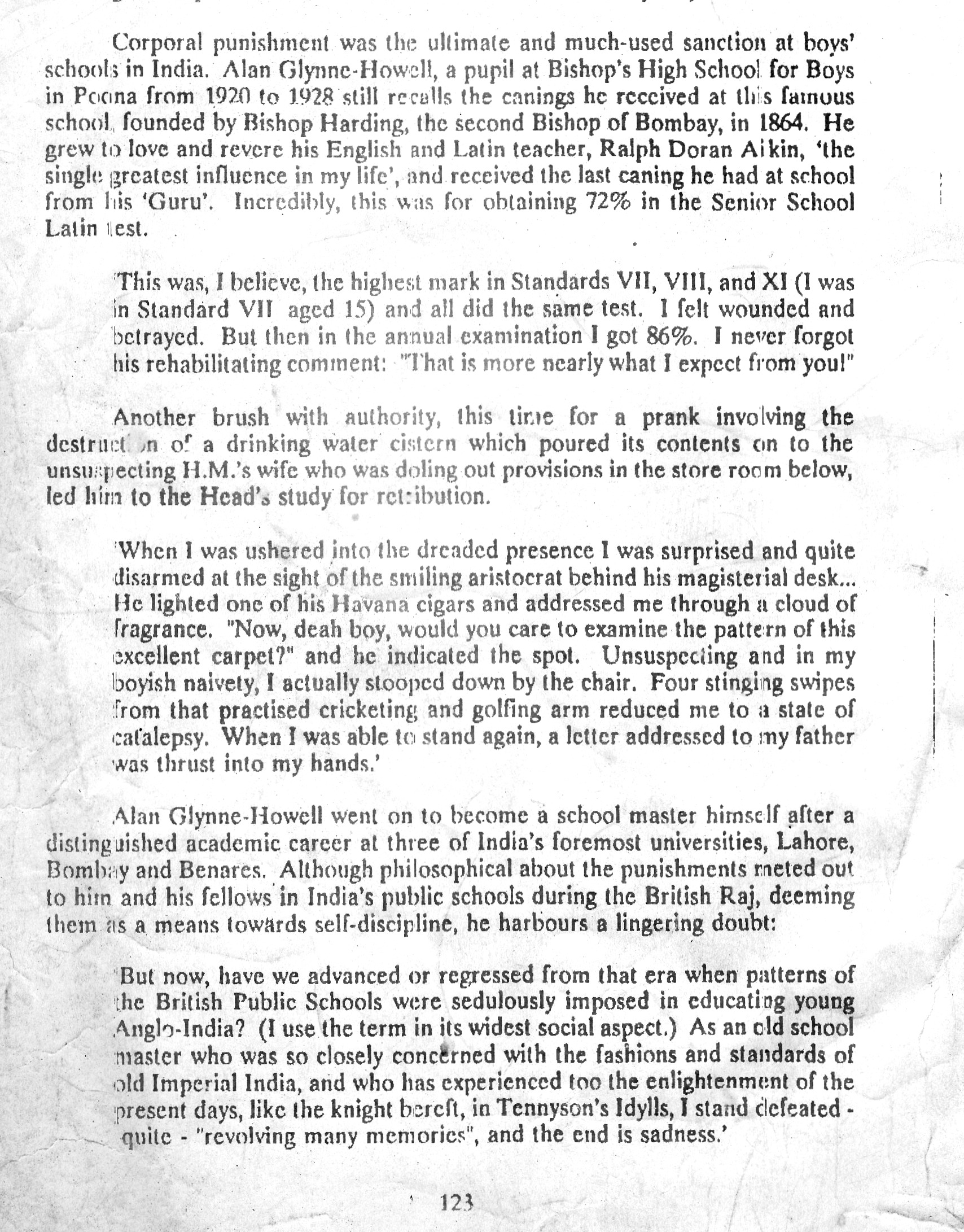

From ‘Under the Old School Topee’, Hazel Innes Craig, British Association for Cemeteries in South Asia (BACSA), Putney (1990, 91, 96).
AGH was one of very few teachers for whom I had great respect. He was a pearl before a load of swines, and I wonder what made such a man want to teach us. Not that I am complaining, but you would have thought that he would have taught in a posh school, where his classical talents would have been appreciated.
I do give him a thought occasionally, because he was influential and had my respect. I would just tell you a few things I recall:
Blood red ink in his fountain pen, which he used to write in a masterful, flowing sort of a way. It was a bit like he was painting with his pen. His signature influenced mine, because he always put two dots under his name. Somehow the two dots conveyed authority. My dots have become a line, but with the same intention.
I took to Latin myself, and failed O level only because the criminally incompetent ***** took over. He (A G-H) was a good Latin teacher, and it’s now part of my kids’ “take the piss out of father” routine to imitate me explaining the meaning of an English word by reference to the Latin derivation. It helped greatly with French and Spanish too. That is in fact Allan’s lasting legacy to me.
He did teach English at some point. I definitely know he taught me (and therefore you, I assume) because I recall him managing to make Shakespeare quite interesting. Maybe he was just standing in.
He was one of the few teachers who always wore his gown, and he would have looked better swaying through the cloisters of some ancient public school, rather than the smelly corridors of Price’s. It was part of his public persona, and added to his considerable gravitas. I now realise that the best teachers are great actors, but it works: We would never have mucked around with him like we did with ******, for example.
The horrible day when somebody had written “Genghis” on the blackboard. He walked in and walked straight out again. I am sure that he took it as a racist insult, and I am sure that it was meant as such. ****** took the blame, but I don’t think it was him at all. I don’t know who it was. I do know that most of us were shocked both by the racism (although we did naively use abusive terminology, I must admit) and by AGH’s reaction. We just didn’t understand about any of that in our 99.9999% white middle class world.
His very Indian way of leaving a long gap before the end of a sentence. I’ll mimic it next time I ……….. see you. It is a good teaching technique. My lecturer at college did the same. It makes you think about how the sentence should …….. end.
I am glad that others remember him fondly. I always say you only die when you’re forgotten, so he’s got a good few years left!
Michael Daysh.
Feb 2011.
Tessa passed away on the 31st August 2013 at the age of 100. My brother Ivor and I were not aware of her passing until some months afterwards. This is the message we then sent to her family :
Ivor and I were pupils of Alan’s at Price’s School. We met Tess only after our school days, when we began to visit Alan following his retirement. After Alan’s death we continued to see Tess: she came to our children’s birthday parties; we invited her for Sunday tea, happily ferrying her from Fareham and back; and we arranged to drop in on her at ‘Everest’ whenever we could. She was always wonderfully positive despite the difficulties of her old age. We saw her last in the Spring. My mother and I went round for ‘elevenses’. Tess was rather deaf by then of course and the conversation was occasionally rather odd as a result, though she had always been quite adept at ‘secretly’ lip reading. However, it was, as always, a pleasure to be with her. We remember her with much love and affection and as one of our special honorary Aunts.
The following games were recalled by my sister-in-law Elaine Bundell (née Vacher). She was born in 1952 and lived as a child in Royton, near Oldham, in the general vicinity of Manchester, in what was then part of the county of Lancashire, in the North of England.
1.
Ping pong pee and the P C lantern
My black cat can play the pianer
He can play for two and a tanner
Kerb or the red brick wall ?
“This was a “choosing” rhyme for a running race game. The children wanting to be chosen stood in a line with both hands held out, palm up. The “chooser” went along the line tapping each hand in turn. The child whose hand was tapped at the end of the rhyme on the word “wall” was the challenger and could choose either the kerb or the wall. (I played this game in the playground at Byron Street Junior School in Royton. I seem to remember there was an undercover area with a kerb to step up into it and a brick wall at the back.) If the challenger chose the kerb then she (again, it was usually a girl) ran to the kerb from a chosen line some distance away, back to the line then to the wall and back to the line again. Meanwhile the chooser ran to the wall first then to the kerb. The winner was the person back to the line the second time. I don’t remember whether the winner became the chooser or if the challenger became the chooser. Even if there were only two people playing, the formality of the rhyming and hand tapping took place.”
This is the game which the Opies[1] call kerb or wall, preceded by a counting out or choosing method commonly used to begin this game. They give the following example of the game’s rhyme:
Bim, bam, boo, and a wheezy anna
My black cat can play the piano
One, two, three, kick him up a tree
Kerb or wall ?
This was reported from Stockport, which is not far from Manchester and Royton. Both rhymes are noticeably nonsensical, especially their first lines, which leads the Opies to add the following disparaging note to their example : `Versions in various stages of decomposition throughout the north country’. It is not clear, however, what the more composed original might have been.
2.
Nebuchadnezzar, King of the Jews
Bought his wife a pair of shoes
When the shoes began to wear
Nebuchadnezzar began to swear
When the swear began to stop
Nebuchadnezzar bought a shop
When the shop began to sell
Nebuchadnezzar bought a bell
When the bell began to ring
Nebuchadnezzar began to sing
Doh ray me far so la ti doh !
“A rhyme for doing “two-ball”. Bouncing two balls alternately against a wall underhand. On each rhyming word, doing a different action, eg throwing one ball overhand, bouncing one ball on the ground before hitting the wall (I seem to remember this was called for some reason “tobogganing”), throwing under the leg against the wall and, the hardest of all, behind the back. Each action lasted for the complete rhyme, saying the rhyme again and doing the next action until the ball was dropped then it was the turn of the next girl (I don’t remember boys ever playing two-ball). I also think that when reciting the “doh ray me” the action was done on every word.”
Steve Roud[2] reproduces the same rhyme, word for word, reported from Kent in the 1940s, also used for games involving the bouncing of balls.
Elaine remembers another rhyme used for playing two-ball:
Lady, baby, gypsy, queen,
Elephant, monkey, tangerine.
“I think it was simply a case of throwing the balls against the wall and doing a different action on the rhyming words.”
Such ball- bouncing games, says Roud, were exclusively girl’s games. They were also `immensely popular’ – which makes it all the more striking that they `seem nowadays to have disappeared’.
3.
Ala–bala–busha
Who’s got the ball ?
See I haven’t got it
It isn’t in my pocket
Ala-bala–busha
Who’s got the ball ?
“This was a ball game where someone threw a small ball over their shoulder to a group of waiting children. Whoever grabbed or caught the ball put it behind their back. Everyone then stood in line with their hands behind their backs saying the rhyme and showing each hand in turn. At the start of the rhyme the thrower turned round and watched the action then at the end of the rhyme had to pick out the child who had the ball. If they guessed right then they had another go and if not then the person with the ball became the thrower. (I remember playing this at the Mission Infants School in Royton and the first thrower was often one of the dinner ladies.)”
This is a version of the game Queenie. ‘Queenie is the perpetual delight of little girls aged eight and nine’ write the Opies. The commonest version of the rhyme begins ‘Queenie, queenie’ but the Opies note that` in Scotland and North-east England’ the rhyme begins instead with` Alabala’. They do not specifically give any example from the Manchester area .
`Alabala’ (also, ‘Ali baba’ and ‘Ala wala’) also occurs in examples of what the Opies call Chinese Counting, so-called not only because a Chinaman often appears, but also – perhaps more so – because the rhymes are made up of nonsense. Elaine remembered this one :
Ah-ra chickara
Chickara rooney
Rooney poony
Ping pong piney
Ala- bala-basta
Chinese Sam
“This may have been a choosing rhyme but I remember girls just walking around arm-in-arm chanting the rhyme.”
*
Mrs Rogers was my class teacher for two years, 1961/62 and 1962/63, my second and third years at Eastwick school. I remember her with great affection. I met her again when she was a hundred years old and had just received a telegram from the Queen. She was delighted to read my News Book – a daily diary – from my years in her class and to see her red ink corrections of my atrocious spellings.
Here is an appreciation of Mrs Rogers written by her son Peter at my request :
My mother, Amy Rosa Rogers (nee Laskey) was the eldest of four sisters, and was born in Twyford, Berkshire on 27th September 1899. She died in Dorset on 5th July 2002. Thus her life spanned 2 millenia, 3 Centuries and 6 Monarchs.
She and her parents moved to Canterbury in Kent soon after she was born, where her father established a market garden. In March 1912 her mother died of TB, and consequently she acted as ‘mother’ to her three younger sisters, and also ran the kitchen in the household. In the following year, 1913, the second eldest also succumbed to TB leaving her to look after the two youngest sisters. By the time The Great War started she was already half way through her Secondary schooling. She excelled at school, was very musical and developed into an accomplished pianist. She became Head Girl and stayed on during the last year of the War when staff were scarce, and took some of the singing classes. She left school in the autumn of 1918, and went to Goldsmiths College London, and particularly remembered the celebrations of the Armistice in the November that year.
After four years at University, she started her teaching career in Kent in 1922, and two years later her father died, again of TB. In June 1928 she married Victor Rogers, and in the autumn moved to Oxted in Surrey where they set up home. In early 1929 her youngest sister died of TB, and in 1930 her eldest son Michael was born. They then moved to Leatherhead in Surrey where in 1933 her younger son Peter was born. In 1937 she returned to teaching to do some supply work at the local Secondary school, and became accompanist for Leatherhead Choral Society. When War broke out in September 1939, she returned to full time teaching at All Saints Primary school in Leatherhead. The school population increased dramatically as evacuee children from London were billeted in the area. All Saints Hall adjacent to the school was used as an overspill, and she and one other teacher, each had a class of sixty children in the Hall – the classes were just divided by a curtain!
After the War ended, she reverted to part time teaching, and the family moved to Great Bookham in 1947. Just before Christmas 1947 her remaining sister died of TB, so she was her families’ sole survivor of this scourge. Apart from part time work, she led a full life within the community in these immediate Post War years, and continued to play for the Leatherhead Choral Society although she now lived in Bookham. She learnt to drive and had her own car, and after her husband died in 1960 she returned to full time teaching at Eastwick Primary school in the village, and continued there until July 1969, just 2 months before her 70th Birthday. At this stage, it was no surprise that Surrey County Education Committee confirmed that she was the oldest teacher on their books!
By this time she had six grandchildren, and loved to see them and hear about their latest exploits. Then in 1976, she moved for the last time, and “retired” to a bungalow Verwood in Dorset. She again led a very active life for many years, taking up both pottery and painting again, and playing the piano accompanying two string players. In 1999 she celebrated her 100th Birthday with the family, which by then included two great grandchildren, and she was very proud to show everyone her birthday card from the Queen! She continued to enjoy a very full life in her bungalow for a further 2 years and only went into care for the last 6 months of her very full life.
Peter Rogers
April 2015